Wednesday, August 27, 2014

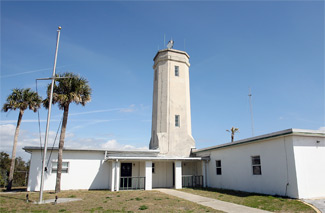
The St John's Lighthouse St John's River, Jacksonville, Florida

Got this one today, August 27th when we visited the Mayport Naval Station to see some of the new ships.  


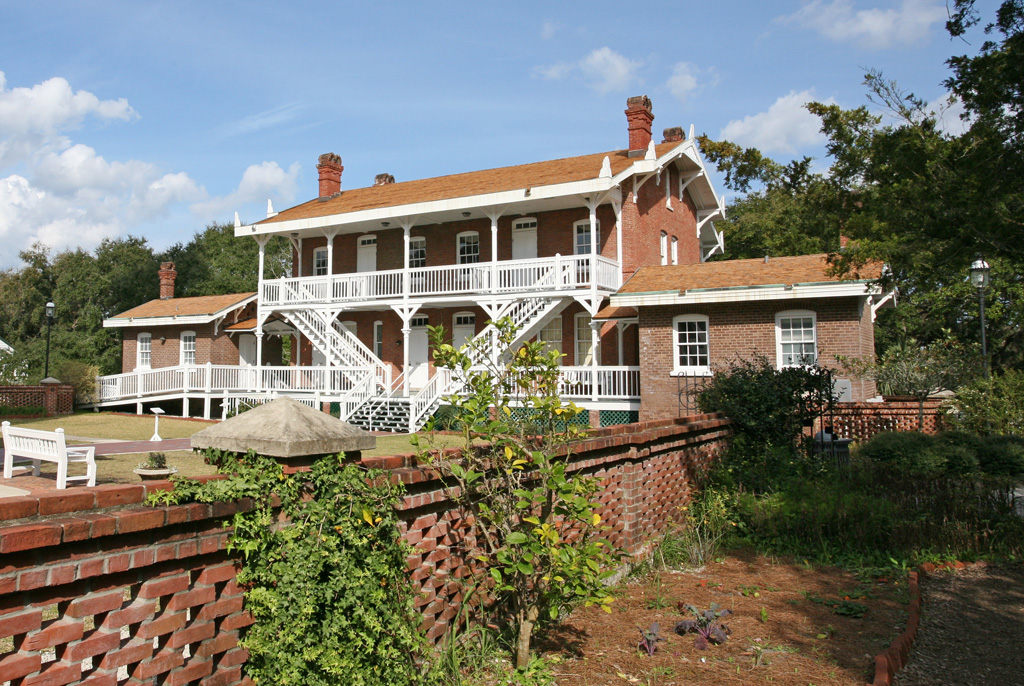
Description: Naval Station Mayport covers 3,409 acres and is home to an aircraft carrier, twenty-one other naval ships, several helicopter squadrons, and two lighthouses. The oldest of the two lighthouses, St. Johns River Lighthouse, was active between 1859 and 1930 and is tucked away in the northwest corner of the station, 1.8 miles from the coast. The station’s second lighthouse, St. Johns Lighthouse, is located right on the coast, about a mile south of the mouth of St. Johns River. St. Johns River Lighthouse was replaced by St. Johns Lightship, anchored seven miles offshore. The lightship served for over two decades, but the expense of staffing and maintaining the floating light, led the Coast Guard to build the modern St. Johns Lighthouse, which replaced the lightship on October 1, 1954.
h courtesy U.S. Coast Guard
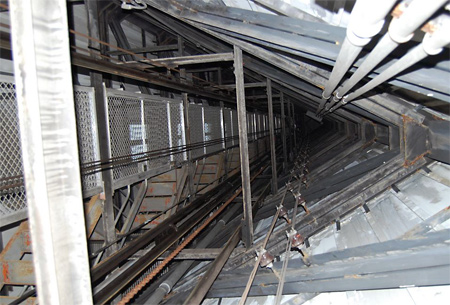
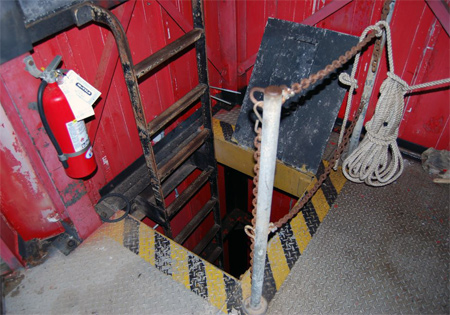
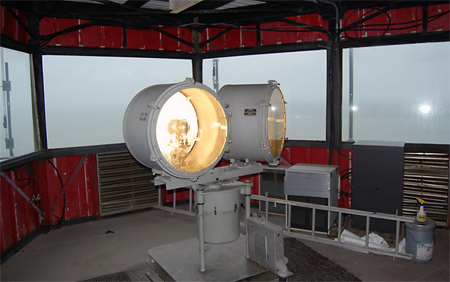
A square, sixty-four foot tower with beveled corners, St. Johns Lighthouse is an art deco tower constructed of concrete blocks and has never had a lantern room. Originally, the lens was shielded by a Plexiglas dome, but today the solar-powered beacon sits fully exposed atop the flat-topped tower. A unique feature designed into the lighthouse was a system of pulleys and wires used to lower the former optic into the tower, where it could be cleaned or repaired, and then raise it back atop the tower.
The lighthouse was automated in 1967, and the dwellings that used to house the coast guardsmen were turned over to the Navy. The two attached, one-story wings, which extend south and west from the base of the tower, are still used by the Coast Guard.
The tragic events of September 11, 2001 are one of the few instances where America has been attacked on her home soil. Another such attack,  also planned by foreign infiltrators, was attempted during World War II. On June 17, 1942, four German saboteurs, carried across the Atlantic by a U-boat, came ashore just a couple miles south of St. Johns Lighthouse with a supply of explosives, primers, and incendiaries to be used in a two-year assault on American defense-related targets. The men buried their boxes of supplies in the sand, and then headed north to start planning the attacks.
Four days earlier, another team of four had landed on Long Island, New York. Fortunately, one of these men had second thoughts and traveled to Washington D.C., where he turned himself over to authorities on June 19. Information gathered from his interrogation resulted in the arrest of the three remaining members of the Long Island group the following day in New York City. Two members of the Florida group were captured in New York City on June 23, and the remaining two men who landed in Florida were arrested in Chicago on June 27. No attacks were carried out before the arrests were made.
A trial, held during the following month, found all eight men guilty and sentenced them to death. The informant had his sentence reduced to thirty years in jail, and another defendant’s sentence was commuted to life in prison. The remaining six were executed on August 8, 1942.

The presence of St. Johns Lighthouse and the large naval force at Mayport will hopefully keep that section of the coast safe for mariners and safe from any future attacks from the sea.

Thursday, April 24, 2014

Sullivan's Island Light Mt. Pleasant SC

Date of visit:  Thursday April 24, 2014


 The modern monolithic Sullivan’s Island Lighthouse, the last major lighthouse built by the federal government, resembles an air traffic control tower more than a traditional lighthouse. The tower's unique triangular shape, with one point directed towards the ocean, allows it to withstand winds of up to 125 miles per hour.
When erosion threatened Morris Island Lighthouse, located south of Charleston Harbor, the decision was made to construct a replacement beacon on Sullivan’s Island, north of the harbor’s entrance. Although the triangular tower, built of concrete and steel and clad in a skin of aluminum, doesn't have much Southern charm, it does have some redeeming qualities. Inside the tower, the keepers of the light are treated to air conditioning and an elevator that offers a leisurely, seventy-four-second trip skyward. After the elevator ride, it is still necessary to scale a twenty-five-foot vertical ladder to reach the lantern room, where a powerful light source is housed.
Charleston Lighthouse in 1962
Photograph courtesy U.S. Coast Guard
When first activated on June 15, 1962, the lighthouse featured an amazing twenty-eight million candlepower light, produced by carbon arc lamps costing $900 apiece, that was the second brightest in the western hemisphere. This powerful beam proved dangerous to its keepers and bothersome to its neighbors. In order to access the lantern room when the powerful lamps were lit, keepers were required to don an asbestos welding suit. To pacify neighbors, plate steel was installed in the landward side of the lantern room. The beacon was downgraded a decade later to a light of just over a million candlepower. Visible from twenty-six miles, the light now has a unique flashing characteristic consisting of a 0.2-second flash, a 4.8-second eclipse, another 0.2-second flash, and a 24.8-second eclipse.
Charleston Lighthouse was originally painted white and red-orange, but the coloring proved so unpopular that the tower's daymark was soon changed to the current black-top, white-bottom paint scheme.
The high-tech Charleston Lighthouse overlooks one of the South’s oldest and most historic cities. Just down the street from the lighthouse is Fort Moultrie, named after William Moultrie a Revolutionary hero responsible for building an earlier fort on the same site. Moultrie and his men repelled a British armada on June 28, 1776, supplying momentum to the quest for independence that would be officially declared just six days later. Fort Sumter is located just offshore from Fort Moultrie. In April of 1860, Confederate forces in Fort Moultrie fired on the Federal soldiers in Fort Sumter, marking the beginning of the Civil War.
The 163-foot-tall triangular lighthouse is not the first to be built on Sullivan’s Island. Records indicate that two "pole-beacon lights" were placed near the southern end of the island near Fort Moultrie in 1848 to guide mariners over Charleston Bar. The range lights were destroyed during the Civil War, but after the surrender of Charleston in the spring of 1865, a temporary, open-framework tower was placed atop a private residence. Formal range lights were established in 1872 with the front beacon being displayed from a wooden tower on the fort's parapet and the rear beacon from a square, open-framework tower. The front range light was moved from the parapet to a point east of the fort in 1878, and the following year, the wooden tower was placed atop a brick basement that functioned as an oil room. The front tower was painted red in 1883.
In 1898, a lifesaving station was built on Sullivan’s Island. The station’s dwelling and boathouse still survive next to Sullivan’s Island Lighthouse, and were used by the coastguardsmen manning the light.
Mike Sejman served at the lighthouse in the 1970s, when the station was staffed by a 1st class petty officer serving as the Commanding Officer, a 2nd class petty officer, and two non-rated crew members. Speaking to a reporter from the The Charleston Observer in 1976, Sejman mused, "It's a little sad sometimes to think that pretty soon they are going to automate the light here and they won't need us any more. I guess all the romance is about gone out of lighthouse keeping. I'm sorry too. I like it."
Sullivan's Island Range in 1885
Photograph courtesy U.S. Coast Guard
Sejman enjoyed showing the public around the lighthouse, which was open to visitors for a few hours on Saturdays, Sundays, and holidays. Due to the inherent danger involved in negotiating the vertical ladder that led to the lantern room, guests were required to sign a release relieving the Coast Guard of any liability in case of an accident. In November of 1976, responsibility for servicing the now-automated lighthouse was transferred to the Coast Guard Station in Charleston.
In 1986, the National Park Service took over the lifesaving station property, excluding the lighthouse, and started to use the historic buildings as offices, maintenance shops, and housing for seasonal rangers.
On May 29, 2008, Charleston Lighthouse was also transferred from the Coast Guard to the National Park Service, which is committed to protecting the historic nature of the property and to prevent commercial development on the site. The Coast Guard will continue to maintain the light, but the Park Service will be responsible for the upkeep of the tower.
On the official transfer day for the lighthouse, Bob Dodson, superintendent of Fort Sumter National Monument, met with Chief Boatswain's Mate Andrew White, the Coast Guard's local officer in charge of aids to navigation, to obtain the keys and security code for the tower and to discuss maintenance and access issues. "You are relieving me of a big burden by taking over the lighthouse," White said, noting that his crew of ten were responsible for monitoring and maintaining about 600 navigational aids along the South Carolina coast. Due to the difficulty of accessing its lantern room and viewing platform, Charleston Lighthouse will not be open to the public on a regular basis, but the Park Service has not ruled out an annual or semi-annual open house.
A celebration for the earlier transfer was held at the lighthouse on November 9, 2008. At that time, the grounds, lifesaving quarters, boathouse, and the base of the tower were open to the public. A symbolic key transfer was held, with local officials participating.

On January 7, 2009, Jack Graham, accompanied by his wife Martha, stopped by Sullivan's Island Lighthouse. Making it to the top of the tower that her husband designed was on Martha's "bucket list." Jack Graham completed his architectural training at the University of Pennsylvania in 1957 under the tutelage of Louis Kahn, who was obsessed with triangles. A year after graduating, Graham learned he would be drafted, so he signed up with the Coast Guard and was stationed at Coast Guard Headquarters in Washington, D.C. In 1959, he was asked to come up with a design for a lighthouse, and given his background, he based it on a triangle, the strongest structural shape. Graham also persuaded the Coast Guard to install the elevator in the lighthouse because of the numerous reported accidents that occurred on lighthouse steps.

Saturday, March 8, 2014

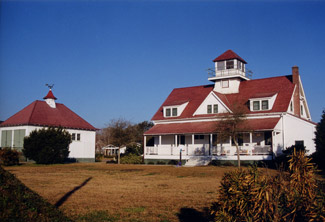
Old Cape Henry Lighthouse Cape Henry Virginia

A 2Fer at Cape Henry...


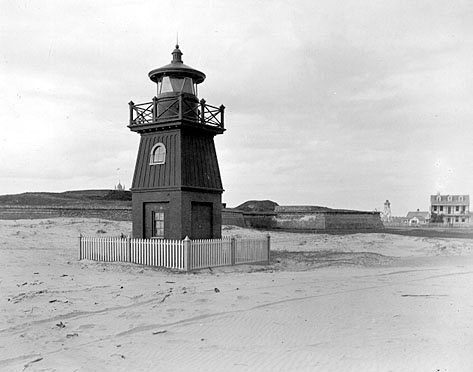
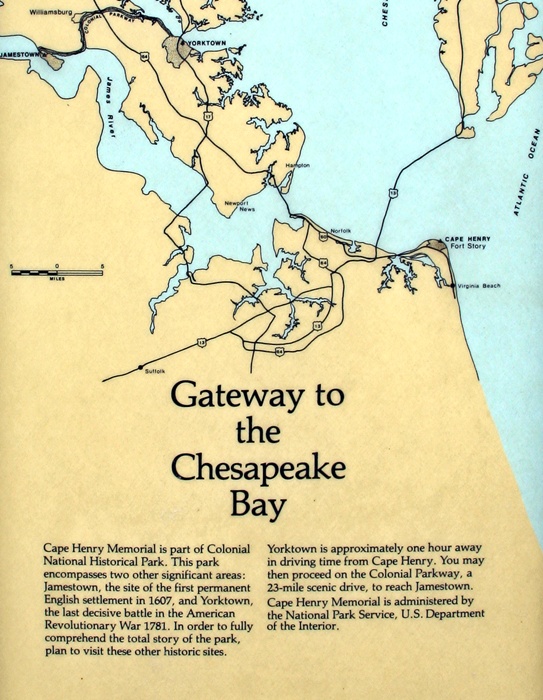
The old masonry light at Cape Henry was a long time coming. For seventy years, the Colonial Assembly of Virginia heed and hawed, passing resolutions and attempting to convince reluctant authorities in Maryland and Great Britain to assist in the construction of a beacon at this vital cape. Standing at the juncture of Chesapeake Bay and the Atlantic Ocean, Cape Henry is the entry point to the ports of Norfolk, Newport News, Baltimore and Washington, D.C.
For many years preceding the birth of our nation, pirates were far more appreciative of the importance of Cape Henry than was the Virginia House of Burgesses. With the cape lacking a proper light, beacon fires were used as a makeshift navigational aid, and unscrupulous men would capture those in charge of the fires and move the light southward to lure ships aground. As the wreckage continued to mount, men like Virginia Governor Alexander Spotswood petitioned the Assembly to take action. In 1720 this body resolved to construct the light, “Provided the Province of Maryland will contribute...”
Receiving little but passive cooperation from their neighbors, the Virginia Assembly was further hampered by the reluctance of the British Board of Trade to grants its permission to proceed. Since the lighthouse was to be financed in part by shipping duties, the consent of this august body was required. Governor Spotswood argued a strong case, describing the plight of merchants too frightened to venture into the Chesapeake during foul weather. He reasoned: “If such a lighthouse were built ships might then boldly venture, there being water enough and a good channell within little more than a musquett shote of the place where this lighthouse may be placed.” Yet it was only in 1758, and at the behest of concerned tobacco merchants, that the Board threw their weight behind the project.
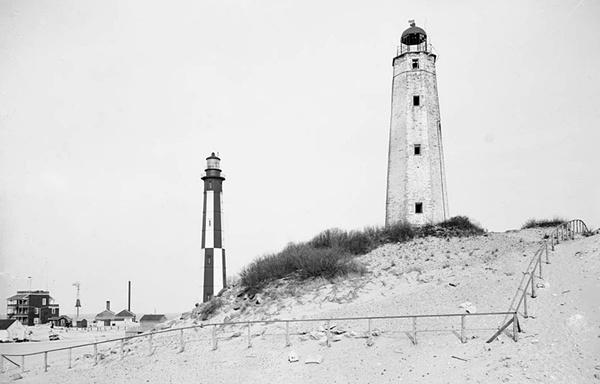
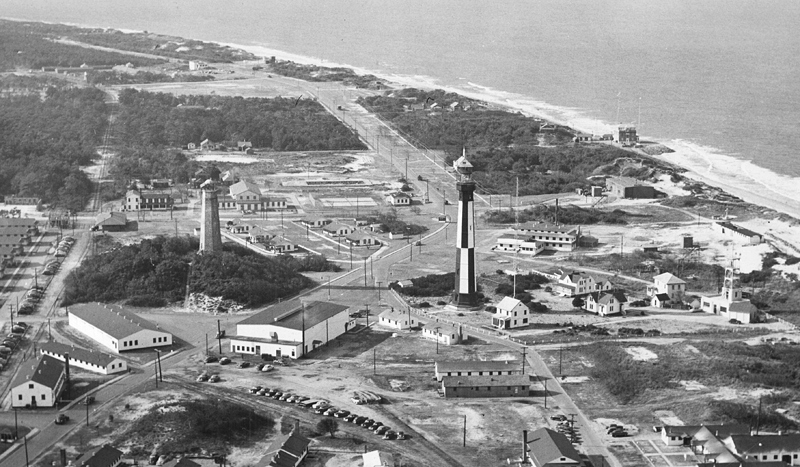
New and Old Cape Henry Lighthouses in 1905
Photograph courtesy Library of Congress
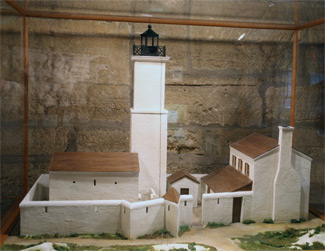
In 1772, the Maryland assembly got on board as well, and the project was underway. Workers’ quarters and stables were built and over 4,000 tons of stone were delivered to Cape Henry. In the summer of 1775, however, the initial allotment of funds was nearly depleted and an additional 5,000 pounds was requested. At this point, the Revolutionary War intervened, and the valuable stones lay forgotten and buried in drifts of sand while more pressing matters were attended to.
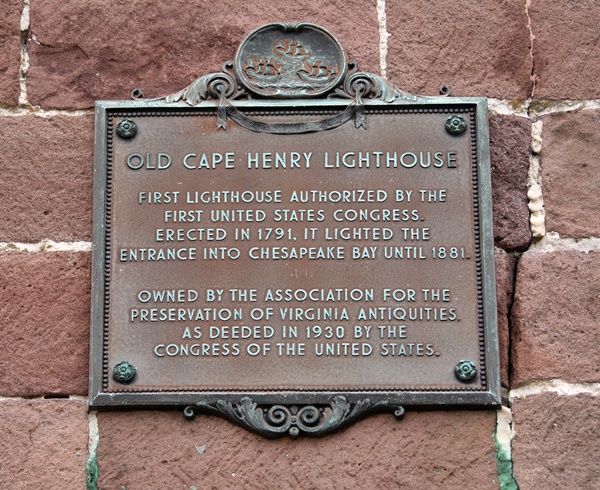
In many respects, Old Cape Henry lighthouse is inextricably linked with the birth of our nation. The Aquia sandstone for its base was gathered from the same Virginia quarries that provided material for Mount Vernon, the U.S. Capitol Building, and the White House. At the first session of the first Congress in 1789, an act was passed which placed the lighthouse service under the jurisdiction of the Department of the Treasury. Included in this act was the provision for the construction of Cape Henry Lighthouse, giving it the distinction of being the first lighthouse ordered and financed by the federal government. The Virginia Assembly, mindful of its own difficulties in building the lighthouse, moved rapidly and ceded two acres in the County of Princess Anne to the United States. President Washington himself took an interest in the construction, noting in a 1790 diary entry that he had spoken with Alexander Hamilton (the Secretary of the Treasury), “respecting the appointment of Superintendents of the Light House, Buoys, etc, and for building one at Cape Henry.”
Secretary Hamilton contracted with a New York bricklayer named John McComb, Jr. to undertake the project at a cost of $15,200. The contract called for McComb, with “all convenient speed, (to) build and finish in a good workman like manner a Light House of Stone, Faced with hewn or hammer dressed Stone...from the bottom of the Water Table up to the top of the Stone Work.” The contract also specified a two-story frame house of twenty feet square, for the keeper, as well as a buried vault for the storage of lamp oil.
The construction proved to be a difficult task, though Hamilton’s representative on the scene describes a highly motivated and uncomplaining John McComb: “He is persevering and merits much for his industry, the drifting of the sand is truly vexatious, for in an instant there came down fifty cart loads at least, in the foundation after it was cleaned for laying the stone, which he bore with great patience and immediately set to work and removed it without a murmur as to the payment for the additional work...” The builder did have to be compensated an additional $2,500, however, as the foundation had to be laid at a depth of twenty feet rather than the planned thirteen, owing to the sandy condition of the ground. McComb estimated that he would finish the lighthouse by October 1792, and this is indeed when it was first lighted.
Lemuel Cornick, who had overseen the construction of the lighthouse, applied to be its first keeper, but President George Washington awarded this honor to William Lewis, who had been one of his loyal troops during the Revolutionary War. Keeper Lewis died just a month after his appointment, and Lemuel Cornick got his chance to run the light. Though he had desired the position, Cornick abandoned the job less than a year later, and Laban Goffigan was made the light’s third keeper.
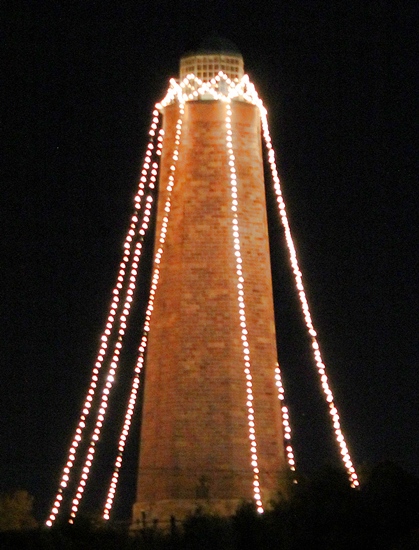
Old Cape Henry decorated for the holidays
Photograph courtesy Stuart Nesbit
Engineer Benjamin Latrobe visited Cape Henry in 1798 and provided detailed descriptions and sketches of the light in operation. One of his drawings shows Old Cape Henry complete with the weather vane, ventilator, and lightning rods called for in the contract with McComb. Latrobe described the lighthouse as “an octangular truncated pyramid of eight sides, rising 90 feet to the light...and six or seven hundred yards from the beach...” This design is basically the same as that of the Cape Henlopen, Delaware tower constructed in 1767. The tower is twenty-six feet in diameter at its base, and the walls there are six feet thick. At its summit, it shrinks to a diameter of sixteen feet. The tower is composed of attractive rosy Rappahannock sandstone which caught Latrobe’s fancy, although he did find fault with the structure on two key points. First he decried “the unpardonable fault of a wooden staircase, which being necessarily soaked with oil exposes the light to the perpetual risk of destruction of fire.” He also sympathized with the plight of the keeper, noticing that the lighthouse, which sits at the summit of a fifty-six-foot-high sandy dune, creates a whirlwind about it which “licks up the sand...and heaps it around in the form of a basin. The sandy rim, while it protects the keeper from the storms, renders his habitation one of the dreariest abodes imaginable.”
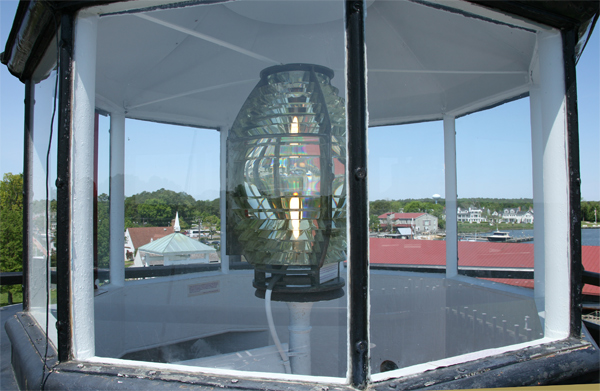
Like most of its comrades, the light at Cape Henry underwent numerous repairs and technological upgrades in the ensuing years. In 1835, a new house was built for the keeper, and in 1841, the lantern was completely redone by Winslow Lewis with eighteen new lamps with brass burners and eighteen reflectors. This work was performed at a cost of $4,000 and included replacement of the wooden deck near the summit with a soapstone deck laid over a brick arch. In 1844, a fifteen-foot-high wall was built around the tower’s base and that area was paved over. In 1855, a fog bell tower was added, and in 1857, the tower was lined with brick and a second-order Fresnel lens replaced the array of lamps and reflectors. Other innovations included the types of oil used in the lantern; these varied from whale oil to cabbage, lard, and kerosene oil, which was adopted near the turn of the century.
The Civil War temporarily put Cape Henry out of commission. In April 1861, men from Princes Anne County seized the tower and destroyed the lamps and lens. It is likely that the Confederate states (including Virginia) feared the formidable sea power of the Union and sought to make it difficult for them to enter the vital Chesapeake. A lightship was anchored off the cape to serve Union forces until 1863, when Cape Henry Lighthouse was repaired, put back in operation, and placed under military guard.
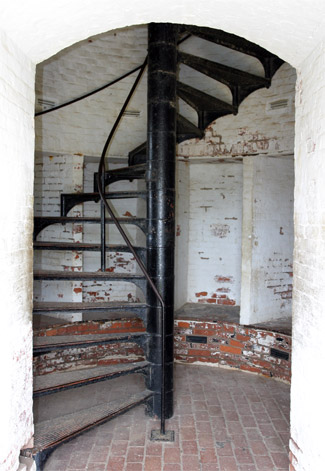
In 1864, an inspector finally corroborated Latrobe’s observation, remarking that Cape Henry was endangered by its oil soaked wooden staircase, which was at this point “greatly decayed and insecure.” The inspector recommended a cast-iron spiral staircase, and this was subsequently installed. The tower remained strong for eight more years, but in 1872 the district engineer noticed large cracks “extending from the base upward” on six of the eight masonry walls comprising the octagonal structure. The inspector concluded that some of these cracks were inconsequential, but those on the north and south faces were compounded by the presence of windows. The inspector concluded that the tower was unsafe and “in danger of being thrown down by some heavy gale.” The construction of a new first-order lighthouse and keeper’s dwelling was recommended, but it took six years for the necessary $75,000 to be appropriated. In 1881, Keeper Jay Edwards transferred his attentions to the new cast-iron structure. Standing 350 feet southeast from the old tower, it was first lighted on December 15, 1881.
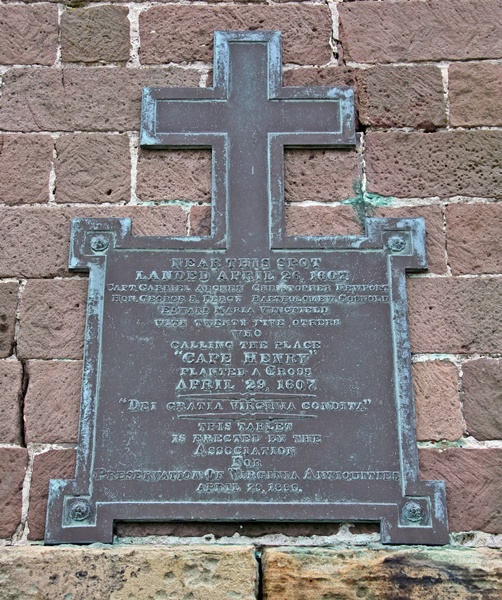
Somewhat surprisingly, Old Cape Henry lighthouse has neither crumbled nor been swept away in a storm. Today it stands in silent idleness, next to and somewhat higher than its replacement, owing to its location on the summit of the dune. It remains an indelible landmark, and in 1896 was graced with the presence of the members of the Association for the Preservation of Virginia Antiquities (APVA). They placed upon the old light a plaque commemorating it as the site of the first landing in 1607 of English colonists on Virginia soil. It thereby became the predecessor of the Cape Henry Memorial, to which its shadow reaches on a late summer afternoon. On June 18, 1930, the U.S. Congress ceded the light and land to the APVA, to be preserved in perpetuity as an historic landmark.

In 1939, Old Cape Henry Lighthouse was selected as the site to celebrate 150 years of the Lighthouse Service, and it was this same year that lighthouse maintenance was transferred from the Treasury Department to the Coast Guard. Today, the lighthouse grounds are encompassed by Fort Story Military Reservation and are a noteworthy destination for visitors to the nearby Colonial National Historic Park. Old Cape Henry is the fourth oldest lighthouse still standing in the United States. The lighthouse was declared a National Historic Landmark in 1964 and a National Historic Civil Engineering Landmark in 2002.

New Cape Henry Lighthouse Cape Henry, Virginia

Got this on the way home from Maine in 2012.  


During an inspection of Cape Henry Lighthouse in 1872, troubling structural damage was noted. The inspector found “large cracks or openings, extending from the base upward,” on six of its eight walls. “Four of these,” he reported, “are apparently less dangerous than the other two, and alone would not warrant any great apprehension of danger, but the latter, those on the north and south faces, where the strength of the masonry is lessened by openings for windows, are very bad, extending from the base almost to the top of the tower.” A new dwelling and first-order lighthouse were recommended as the existing tower was “in danger of being thrown down by some heavy gale.”
New Cape Henry Lighthouse and Old Cape Henry minus its lantern room
Photograph courtesy U.S. Coast Guard
A similar warning was repeated each of the following years until Congress finally granted an appropriation of $75,000 in June 1878 to replace Cape Henry Lighthouse. With funds finally in hand, the Lighthouse Board proved itself more than eager to begin the project. In its 1879 annual report, the board enthusiastically reported: “The drawings and specifications for a new 1st-order light house are now completed and ready for distribution to bidders.” Negotiations for six acres of land were also underway, and the search was on for contractors to complete the metalwork. As this new light was to be composed of enormous cast-iron plates bolted together, this was a tall order indeed (the tallest cast-iron, fully enclosed lighthouse in the United States, in fact). The board was emphatic that “no unnecessary delay will be made in the prosecution of this important work,” and they requested $25,000 more in funds to move the project along.
In 1880, the Lighthouse Board insisted that steady progress was being made, in spite of delays in the metal work and land negotiations: “...about one third of the wrought iron work has been completed. The base section, comprising about 16 feet in height of the tower, is nearly completed.” An 1880 photograph shows construction materials strewn around a base section just starting to emerge from the sand, with the reliable old stone tower standing staunchly in the background.
A pier was completed near the construction site in August 1880, and soon thereafter “the broken stone for concrete, the hoisting-engines and steam concrete-mixer, 600 barrels of imperial Portland cement, brick for the fog-signal building and the fog-siren machinery, with the exception of the boilers, were landed.” After enduring these tons of bricks and machines, the pier proved too fragile for a load of tower ironwork, and the bridge leading from the loading dock to the shore broke under the strain of a fully loaded car. The remainder of the off-loaded ironwork was transported to Norfolk by a hastily procured schooner and placed in storage. Just hours after the load was removed, the pier collapsed entirely.
The failure was not totally the fault of the pier-builder; examination of the wood revealed that a boring worm had devoured much of the structure, weakening it considerably. The Lighthouse Board decided that rather than rebuild the pier a tramway would be extended four miles to Lynnhaven Inlet, where scows (flat bottomed freight boats) would be used to land construction materials.
When work was suspended for the winter in November 1880, a brick fog signal building, covered by a corrugated iron roof, had been completed, and one worker remained behind to watch over the property and supplies. The first-class steam siren housed in the fog signal building commenced operation on December 1, 1880.
Work on the lighthouse resumed on May 30, 1881 and progressed smoothly from this point forward. By mid-June the extensive preparatory work had been completed; this included relaying portions of the tramway that had washed out and “putting hoisting engines in order, erecting derricks and preparing cars for hauling.” The remaining metal plates, their completion long delayed by inept contractors, were finally ready to be shipped from their foundries in mid-July, and a first-order Fresnel lens was awaiting shipment from the Staten Island depot to Virginia.
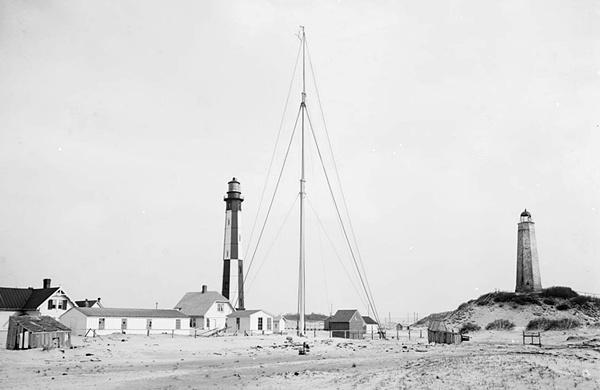
New and Old Cape Henry Lighthouses in 1905
Photograph courtesy Library of Congress
A course of cut granite was laid atop a massive concrete foundation to serve as the base for the ironwork. Having been marked in the foundry, the massive iron pieces were quickly set in place in the tower – the bottom section of the tower was commenced on July 8, and the sixth and final section was in position on September 8. During the remainder of September, the service and watch rooms were completed, and the interior of the tower, consisting of the stairway, landings, and lining, was finished on November 15. The first-order lens was tested on November 27 and “found to work admirably.” Freshly painted, the lighthouse was officially turned over to Keeper Jay Edwards on December 15, 1881 and placed in operation that evening with its light shining at a focal plane of 157 feet and visible for up to 18 ¾ miles. In just one day, the old tower, which was left standing as a daymark and as a basis for coast survey triangulation, transitioned from a lighthouse to a historic landmark.
The two towers continue to stand side-by-side on the southerly Cape of Chesapeake Bay, one of the most important shipping channels in the nation. The vital ports of Norfolk, Newport News, Baltimore and Washington are all accessed through the Chesapeake, and the Cape Henry lighthouses have provided over two hundred years of uninterrupted aid to navigation.
New Cape Henry Lighthouse is adorned with one of the most distinctive daymarks to be found on a lighthouse anywhere in the world. Its stark octagonal tower alternates between white and black on its various faces, and midway up this pattern is offset by one face, producing a checkerboard-like effect. The unique coloring distinguishes Cape Henry from the all-white tower of Cape Charles to the North and the redbrick tower at Currituck Beach to the South.
In July 1887, a system of magneto-electric call bells with an arranged code of signals was installed at the station to connect the tower, fog signal building, and dwellings, and in April 1888, a 79° red sector was placed in the lens to cover dangerous shoals at the entrance to the bay. In 1892, a brick oil house, capable of storing 500 five-gallon oil cans was erected near the lighthouse along with a summer kitchen.
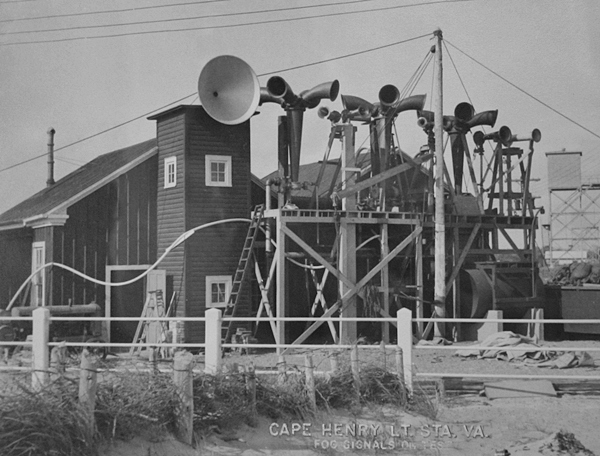
Cape Henry's Fog Signal Testing Station
Photograph courtesy National Archives
Milton L. Odell replaced Jay Edwards as keeper of the new lighthouse in 1885, and it wasn’t long before he was embroiled in controversy. Charges of “neglect of duty, misappropriation of government property, and of offensive partisanship” brought against Odell were disproved before the Lighthouse Board, but the men who sought Odell’s job didn’t stop there. As Keeper Odell was returning to the lighthouse on horseback in December 1887 after being on sick leave in Norfolk, he was fired upon by three men. The keeper returned fire after recovering from the initial shock of the attack and believed he must have hit one of the assailants as he heard a cry of pain. As proof of the attack, Keeper Odell was left with two bullet holes in his gum coat.
During the twentieth century, Cape Henry Lighthouse saw many technological upgrades that have accumulated to make it the very modern aid to navigation station that it is today. In 1912, an incandescent oil-vapor lamp replaced a lamp with five concentric oil-burning wicks, and ten years later, the light was converted to electricity and its characteristic changed from fixed white to a group of three flashes every twenty seconds. At the time of electrification of the light, experiments were conducted at Cape Henry to determine what type of bulb and how many were needed, as it was feared that a single electric bulb would not provide sufficient light to reach all the prisms of the lens.
A radiobeacon was placed in commission at Cape Henry on June 1, 1923, making it one of the first lighthouses in the United States to deploy such a device. After an electrically operated oscillator replaced the first-class siren, it was possible to conveniently synchronize the fog signal and radiobeacon, and on February 26, 1929, a distance-finding test was conducted off Cape Henry and found that by noting the difference in time between the reception of the radio signal and the audible fog signal a vessel could determine its distance from the lighthouse with sufficient accuracy for navigation. The setup was officially commissioned on May 23, 1929 as the country's first synchronized distance-finding system.
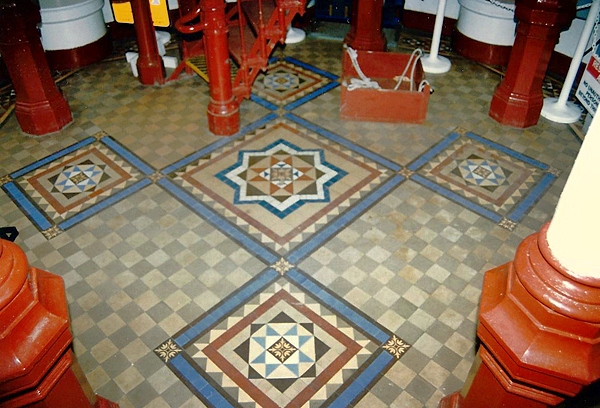
Beautiful tile floor inside lighthouse
Photograph courtesy Al Smith
Cape Henry became home in 1934 to a fog signal testing laboratory, where investigations were conducted for the benefit of the entire Lighthouse Service. Indeed the station has been of great scientific importance, as experiments in radar and wind-generated electricity were also conducted there. In 1996, Cape Henry leaped into the twenty-first century when a Differential Global Positioning System was installed.
Since 1984, Cape Henry Lighthouse has been fully automated, rendering the presence of a keeper unnecessary. Budget restrictions have forced the U.S. Coast Guard to examine the “prohibitive costs of maintaining the historical integrity of the structure.” The Coast Guard is responsible for 50,000 aids to navigation, only about 500 of which are lighthouses. In a memo from the late 1980s, the commander of the Fifth Coast Guard District defended his decision to continue maintenance of New Cape Henry Lighthouse: “You...recommended that we excess the structure and... build a skeleton tower for the required optic. … As the program manager, it is my decision to retain this lighthouse as one of the major landfall aids for the Chesapeake Bay entrance. A skeleton tower would not present the same visual daymark as the current 165-foot tower."

Some within the Coast Guard proposed demolishing the tower, hoping that a historical society would then step in to save the lighthouse. Even without the threat of demolition, it seems this goal just might be achieved. In 2005, Virginia’s most experienced historic preservation organization, the Association for the Preservation of Virginia Antiquities (APVA), requested control of the lighthouse from the Coast Guard. APVA already runs the old lighthouse just 100 yards away, and if successful in obtaining the new one, they plan to open the iron tower for climbing, and the associated two keeper’s quarters for tours. Cape Henry would certainly become one of the top lighthouse destinations if this occurs.

Hooper Strait Lighthouse, St Michael's Maryland

Got this on the way back from Maine in the summer of 2013:


Hooper Strait is a roughly mile-wide passage that connects Chesapeake Bay with Tangier Sound. The eastern Maryland mainland forms the northern boundary of the strait, and Bloodsworth Island, once renowned as a haven for pirates, is located on the southern side. Captain John Smith gave this entrance into Tangier sound a name that conjures up an image of the many contortions required of mariners to pass through the area’s dangerous shoals: Limbo Straits.
Efforts to shine a light on this precarious place began with light-vessel deployment, with the first of these floating beacons being stationed at Hooper Strait in 1827. The ship’s fixed white light was elevated to a focal plane of thirty-four feet and could be seen from ten miles. The last light vessel sent to keep watch at Hooper Strait was built in 1845, and was destroyed by Confederate guerrillas in the Civil War.
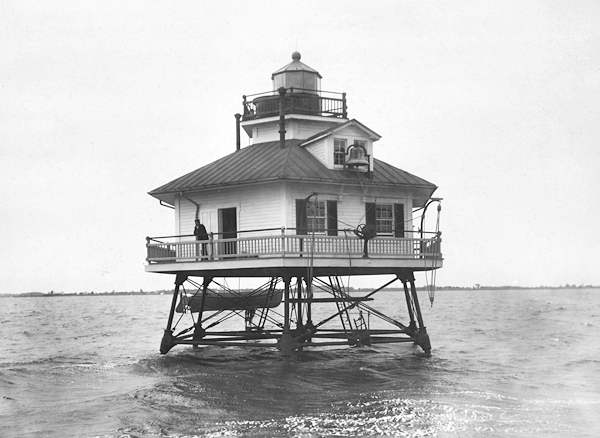
Hooper Strait Lighthouse in 1916
Photograph courtesy U.S. Coast Guard
Following the war, the Lighthouse Board took advantage of the opportunity to implement a long-desired plan, namely to replace lightships, wherever possible, by permanent structures that were less costly to build and maintain. During the twelve-month-period ending June 30, 1867, screwpile lighthouse were erected at eight stations in the Fifth Lighthouse District that were formerly served by lightships for a total cost of $121,001.
The screwpile lighthouse placed in Hooper Strait consisted of a square dwelling surmounted by a lantern room, and it first exhibited its fifth-order light on the night of September 14, 1867. The structure served faithfully for nearly ten years before being destroyed by ice on January 11, 1877. Three days of building ice and tidal pressure was enough to snap the bolts that held the foundation braces together, and the unsupported dwelling quickly sank up to its roofline, with John S. Cornwell, the light’s first head keeper, and his assistant Alexander S. Conway still on station. The two keepers escaped the lighthouse using one of the station’s boats, which they pulled over the ice.
For twenty-four hours, the keepers remained stranded on the ice with only the boat to shelter them. Captain Murphy of Billy’s Island finally rescued the keepers, who suffered severe frostbite from the prolonged exposure.
Two lighthouse tenders, the Tulip and Heliotrope, were dispatched to find the castaway house, which they located five miles south of Hooper Strait submerged to its roof in water. The crews were able to salvage the lens, lamp, and fog bell, but had to call off further operations due to dangers from the heavy ice.
In reporting the incident, Keeper Cornwell apologized for his inability to submit his quarterly report as it had been lost with the lighthouse. Though frostbitten, Keeper Cornwell insisted that “should there be another house erected, or a boat placed in the site of the old one, Capt. Conway and myself will be ready to take charge of it...”
On June 20, 1878, Congress appropriated $20,000 for a new screwpile structure at Hooper Strait. This cottage-style lighthouse was constructed at the Lazaretto Depot in Baltimore and consisted of a hexagonal dwelling, painted white and topped by a black lantern. When completed, the superstructure was transported by schooner to the site, where the screwing down of the seven iron support piles had commenced on September 21. The Annual Report of the Lighthouse Board for 1880 records: “The piles were placed in their position without any difficulty, the struts, tension bars, and sockets were fitted in place, and the wooden frame of the house was raised. The structure was ready for lighting early in October and on October 15, 1879, its light shone for the first time.” True to his word, Keeper Cornwell did return to his post and keeper of Hooper Strait Lighthouse. The Lighthouse Board was confident that the new lighthouse, which was mounted atop solid, wrought-iron piles with a diameter of ten inches, would fare much better than its predecessor, which rested on “sleeve-piles.”
Buy at Art.com
Buy From Art.com
In 1882, the station’s light, which was originally fixed-white, was outfitted with red sectors to warn mariners of shoals in the strait. The effects of the Charleston Earthquake of 1886 were felt at the station by Keeper Zebedee Harper, who had just replaced Keeper Cornwell the previous year. Keeper Harper provided the following information on the quake to the Lighthouse Board: “…an earthquake shock occurred at 9.55 p. m. on August 31, which lasted about a minute and a half. There were two shocks; the first at 9.55 and the second about 10 o'clock. They were both light, but they set the weights in the windows to rattling. There was no other noise than a rumbling at the time, and the weather was clear, with a moderate breeze.”
In September 1918, Keeper Calvin Bozman sailed back to the lighthouse after a short shore leave to relieve assistant Ulman Owens. Several days later, the captain of a steamer noticed the lighthouse was dark and notified the Lighthouse Service in Baltimore. Keeper Bozman’s body was discovered a short time later drifting in the strait by the captain of an oyster schooner, and a formal investigation determined that the keeper had fallen off the lighthouse’s storage platform while sawing wood and drowned.
An even more gruesome fate was to befall Ulman Owens, who eventually ended up as keeper at Holland Island Bar Lighthouse after having earlier served seven years as assistant keeper at Hooper Strait. In 1931, authorities visited Holland Island Bar Lighthouse, after its light had not been seen on the nights of March 13 and 14, and found Keeper Owens’ body lying on the kitchen floor with its left arm stretched out toward a blood-covered butcher knife. While the official cause of death was listed as natural causes, the fact that the lighthouse had been ransacked and that Owens’ body had sustained injuries leads many to believe that the keeper was killed by a rumrunner or a jealous husband.
Hooper Strait Lighthouse was staffed until 1954, when it was completely automated and Keeper George Leikam was transferred to Thomas Point Lighthouse. Despite having its windows boarded up, the inevitable occurrence of vandalism and decay took its toll on the lighthouse. By 1958, the cost-conscious Coast Guard had initiated a policy of simply burning the screwpile dwellings or paying a contractor to demolish them. The bare screwpile foundation was then used for setting up steel perimeter and radial beams to support a skeletal tower that displayed an automated light at the same height as the original lantern. While inelegant, the result was extremely utilitarian and allowed the Coast Guard to escape the massive commitment of maintaining abandoned lighthouses. In 1966, the Coast Guard planned to rid itself of Hooper Strait Lighthouse either by burning it or hiring a demolition contractor, but before the lighthouse suffered such an ignominious end, the Chesapeake Bay Maritime Museum stepped in and saved the historic structure.
Aided by the Historical Society of Talbot County, which raised $12,500, and the U.S. Treasury, which contributed the $14,000 allotment for the aborted demolition, the museum hired The Arundel Corporation to lift the forty-two-ton lighthouse from its pilings and barge it forty miles up the bay to St. Michaels. A Baltimore firm called Pile Drivers built a new foundation out of tubular steel at the museum using piles provided at cost by the Union Metal Company, also of Baltimore. The piles were sunk twenty-eight feet and then filled with concrete. The steel plates and eight-inch steel beams, which form the support platform atop the piles, were generously donated respectively by the Easton Steel Company and the Chase Steel Company. Sheared in half directly below its eves and sundered from its foundation in Hooper Strait, the structure waited out high winds and waves before arriving at its final home at Navy Point on November 9, 1966.

Today, the lighthouse is the museum’s most popular and recognizable exhibit. A Fresnel lens housed in the lantern room originally produced a very unique flashing pattern, CBMM in Morse code, but a historically accurate steady white light is now shown. Although the lighthouse is perched above dry land, the interior exhibits give a sense of what life must have been like for an offshore keeper and also provide a brief history of the lighthouse service. Since 2004, the museum has opened the lighthouse to those who would like to experience a night in the life of a keeper. Visitors who sign up for the program are fed dinner, taken on a unique tour of the lighthouse, and are divided into watches and encouraged to engage in some of the daily chores typical of a nineteenth-century light station. The experience culminates with a night’s sleep inside the structure itself, which now overlooks the Miles River. The overnight adventure is a wonderful opportunity to get up close and personal with one of the few remaining screwpile lighthouses out of the forty originally built on Chesapeake Bay.

Fort Niagara Lighthouse Buffalo New York

This is a beautiful light at Fort Niagara, right on the lake north of Buffalo-  there this summer 2013. 


Several lighthouses have marked the point where the Niagara River joins Lake Ontario near Youngstown, New York. This area attained importance in the late 1600s when French fur traders used the Great Lakes to transport their goods. Niagara Falls separated the supply of furs to the west with the demand that lay to the east, forcing the traders to use bateau (flat-bottomed, shallow-draft boats) and canoes to portage furs around the falls. The mouth of the Niagara River became an ideal point for transferring the furs to larger ships, and since that time, it has served as an essential harbor as well as a point of strategic importance during multiple wars.
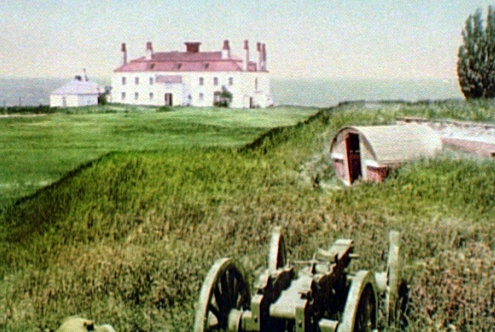
A predecessor to the current Fort Niagara was built in 1679 by the French and was named Fort Conti and then Fort Denoncille. In 1726, the still-standing “French Castle” was built, intended as a gathering place where colonists could find protection from hostile Native American tribes. At this time, the fort and vapor of Niagara Falls served as useful navigational markers during the day, but at night mariners lacked any sort of guide.
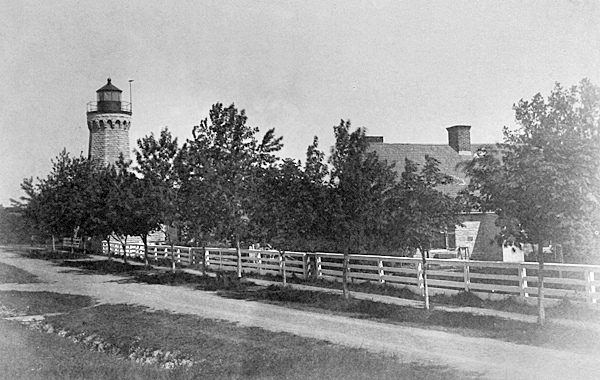
Fort Niagara circa 1900 with possible remains of tower
Photograph courtesy Library of Congress
In 1759, the British captured Fort Niagara after a nineteen-day siege that was part of the French and Indian War. Due to the increase in vessels on the Great Lakes after this conflict, the British placed a beacon on the roof of the fort in 1781. This was the first unofficial lighthouse on the Great Lakes, and like most of its contemporaries, it was probably illuminated with whale oil. The light's primary purpose was to keep vessels from drifting too far west of the fort at night.
Fort Niagara was relinquished to the United States in 1796 after the Revolutionary War, and the roof light remained active until 1803. The British garrison across the river at Fort George constructed the Newark Light in 1804, the second lighthouse to serve the area. This lighthouse survived the War of 1812, but in 1814, it was demolished to clear a site for the construction of Fort Mississauga. The next light to mark the mouth of the river was established in 1823, after Congress provided $1,000 on May 7, 1822 for “placing a lamp on the mess-house at Fort Niagara” and $1,500 on March 3, 1823 for “completing a tower for the light on Fort Niagara.” Vessel traffic in the area declined after the opening of the Erie Canal in 1825 reduced the need for the difficult Niagara portage.
Fort Niagara and its lighthouse were involved in the William Morgan affair, an 1820s political scandal. Morgan, a renegade Freemason who threatened to go public with obscure Masonic rituals, was kidnapped and held at Fort Niagara shortly before his disappearance in 1826. Edward Giddings, keeper of the lighthouse at the time, was suspected of having been involved in the detainment of Morgan at the fort, but no one was ever punished for his death. The incident caused a national sensation over dark Masonic conspiracies, leading to the creation of a short-lived anti-Masonic political party.
In 1829, the Canadians opened the privately-financed Welland Canal, which provided a navigable link between Lake Ontario and Lake Erie and eliminated the need to haul vessels overland. Despite this improvement, enough sailing and steam vessels remained on the Niagara River to justify a light at the river’s mouth.
The following report on Fort Niagara Lighthouse was made in 1838 by Naval Lieutenant Charles T. Platt: “This light is situated on the mess-house, within Fort Niagara, at an elevation of 70 feet above the water. It is a good light-house, situated at a point convenient for the mariner, and the excellent order in which it is conducted gives high credit to the keeper. It is lighted with 9 lamps and an equal number of reflectors, fixed.”
Lighthouse and dwelling in 1885
Photograph courtesy National Archives
In 1855, the keeper’s dwelling and other outbuildings at Fort Niagara were damaged by a tornado, and in 1857 the tower was outfitted with a fourth-order Fresnel lens, and new lantern room which had just 9 panes of glass instead of the 150 used by its antiquated predecessor. The Lighthouse Board requested a new lighthouse for the fort in 1868 as the current wooden tower was so “old and out of repair” that it let “in the snow and rain in stormy weather.” Four chimneys surrounded the octagonal tower, and the previous winter a spark from a chimney caused a dangerous roof fire, which could have easily destroyed the tower’s valuable lens. Moreover, the tower was poorly situated, as it required using “the stairway and passages of the officers’ quarters as a thoroughfare for the supply of the light.”
While waiting for funds for a new lighthouse, the keeper’s dwelling was reshingled and equipped with shutters and rain gutters, and a woodshed, privy, and a barn were built for the keeper.
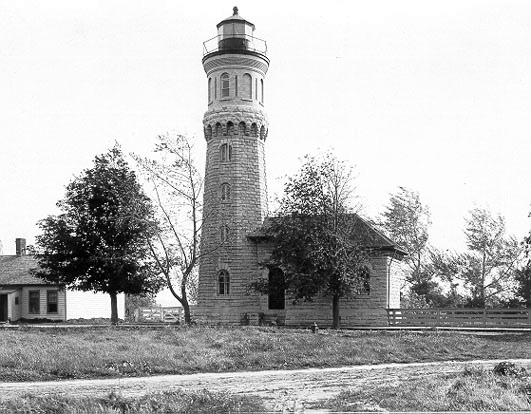
After Congress provided $16,000 on March 3, 1871 for a new lighthouse, plans for a fifty-foot octagonal limestone tower with an attached oil room were drawn up. Work on the structure, which was placed outside the fort’s walls near the stone keeper’s dwelling, commenced in July of 1871, but masonry work had to be suspended on November 30th due to the early arrival of cold weather. Work resumed on April 15th of the following year, and the light from the fourth-order Fresnel lens, transferred from the old tower, was first exhibited on June 10, 1872. The light's focal plane was raised eleven feet, four inches in 1900, when a brick watch room was added between the top of the stone tower and the lantern room.
The military's water main at the fort was tapped in 1889 to provide water for the light station. Also that year, the roof of the station's barn was re-shingled and a wagon shed measuring twelve by sixteen feet was constructed for the convenience of the keeper. In 1894, the Lighthouse Board noted that the keeper's dwelling was “old, in bad condition, and unsuitable” and requested $4,000 to build a new one. Under a contract of June 25, 1896, a six-room, two-story keeper’s dwelling was built 140 feet west of the lighthouse, following plans that had been used for dwellings at Dunkirk and Oswego. At the same time, the “grade of the lot around the dwelling was raised,” and a gravel driveway leading from the lighthouse reservation to a nearby street was made.
In 1899, the Lighthouse Board requested $2,000 to place a light atop a twenty-five-foot tower closer to Lake Ontario to help vessels safely reach the protected anchorage offered by the river. At the time, no port for deep-draft vessels existed along Lake Ontario's south shore between the Genesee River and Port Dalhousie, a distance of nearly ninety miles. This request was repeated annually for six years, but appears to have gone unfulfilled. In 1905, a square iron oil house with a capacity of 540 gallons was erected twenty-five feet south of the lighthouse, and the former oil room was converted into an office and storeroom.
On August 28, 1919, Fort Niagara Lighthouse was electrified allowing for its characteristic to be easily changed from fixed white to four seconds of light followed by a two-second eclipse.
Fort Niagara Lighthouse in 1903
Photograph courtesy U.S. Coast Guard
George F. Ferguson was serving as keeper of the lighthouse in 1929, when he traveled to the Cleveland Clinic for a throat operation. On May 15, Ferguson was walking down a hall after having just undergone a final examination prior to his discharge when a massive explosion knocked him to the floor. The explosion and resulting fire, which killed 123 people, was caused when nitrocellulos x-ray film was ignited by an exposed light bulb. The burning film produced poisonous gases that caused many patients in the clinic to suffocate. When Keeper Ferguson returned to Buffalo, he declined to be interviewed saying, “My nerves are wrecked, I can’t talk about it.” Keeper Ferguson also served as secretary of the Old Fort Niagara Association, and while tearing down some plaster at the fort, he discovered a piece in which the names of four Frenchmen and the years 1741 and 1742 were scratched.
During the prohibition era, Keeper Ferguson was captaining a captured speedboat with 400 gallons of alcohol aboard to the Coast Guard station at Fort Niagara in June 1926, when the vessel caught fire. Ferguson and a deputy sheriff, the only other person aboard, quickly leaped into the vessel’s small dory that was in tow and watched as the speedboat exploded and burned to its waterline. Two Canadians and two Americans were loading the speedboat with alcohol when it was seized by authorities. Keeper Ferguson received a citation from the federal government for his part in the rescue on February 3, 1917 of a young man whose boat was caught in an ice jam at the mouth of Niagara River.
Rather than remove or trim roughly fifty trees that were starting to obscure Fort Niagara Lighthouse, the Coast Guard decommissioned the historic sentinel in 1993 and replaced it with a light on a nearby radio tower. Nancy Price, who had lived in the keeper's dwelling while her husband, Richard, was officer in charge of the Fort Niagara Coast Guard Station from 1968 to 1975, was given the honor of throwing the switch to activate the modern light. Minutes later, her grandson was permitted to pull the plug in the lantern room of the historic lighthouse to darken the Fresnel lens.

The historic lighthouse is currently leased to the Old Fort Niagara Association, which at times has kept a small museum and gift shop in the tower. The Fresnel lens was removed from the tower in 1995 and is on display at the visitors center at Old Fort Niagara. The association holds a number of interesting historical events at the fort each year covering the French and Indian War, Revolutionary War, and the War of 1812. Open year round, Old Fort Niagara boasts both an extensive collection of 18th century military architecture as well as splendid examples of military engineering. In 2013, the windows in the lighthouse were replaced using a $10,000 donation from the East Hill Foundation of Western New York

St. Augustine Lighthouse, St Augustine Florida

My "home" lighthouse.


St. Augustine, the oldest permanent European settlement on the North American continent, is affectionately called the Old City. Don Juan Ponce de Leon discovered La Florida, the "Land of Flowers," in 1513 for Spain. Roughly fifty years later, Spain made a serious attempt at colonizing Florida, when Don Pedro Menendez de Aviles was dispatched to the area. Menendez arrived off the Florida coast on August 28, 1565, the Feast Day of St. Augustine, and soon the fledgling colony of St. Augustine was established.
Near St. Augustine the Matanzas River empties into the Atlantic, flowing past barrier islands named Anastasia and Conch. On the northern end of Anastasia Island, several towers have been built through the years overlooking the inlet that leads to St. Augustine. Early on, the Spanish constructed a wooden lookout tower. Later, a more permanent tower was built using blocks of coquina that was formed as large deposits of shells were cemented together over time by calcium carbonate. Spain ceded control of Florida to the English in 1763 to regain control of Cuba. However, under the 1783 Treaty of Paris, control of Florida was returned to the Spanish, who controlled Florida until they relinquished it to the United States in 1821.
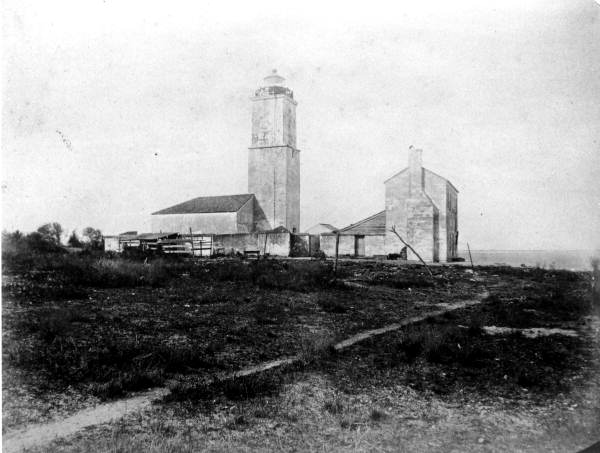
Early St. Augustine Lighthouse
Photograph courtesy State Archives of Florida
As St. Augustine was the leading port in the newly acquired Territory of Florida, the U.S. Government worked quickly to establish a light to mark the inlet. John Rodman, the customs collector at St. Augustine, proposed that the old Spanish tower be converted into a lighthouse, and Congress appropriated $5,000 on March 3, 1823 for performing the work. With a height of roughly thirty feet, the modified tower was placed in service in 1824. Juan Andreu, a Minorcan, was paid $350 a year to care for the lighthouse and tend the ten oil lamps, set in silver, bowl-shaped reflectors.
The lighthouse was outfitted with a fourth-order, revolving Fresnel lens in 1854, and by this time the height of the tower had been increased to over fifty feet. In 1859, Joseph Andreu, son of Juan Andreu and the fourth head keeper of the light, fell sixty feet to his death when the lashing of the scaffolding gave way while he was whitewashing the tower. Joseph's wife, Maria Mestre de los Dolores Andreu, took over as keeper and served until the light was extinguished shortly after the outbreak of the Civil War. Joseph Pacetti, a Confederate soldier, was wounded while removing the lens from the lighthouse so that the Union forces could not take advantage of it.
After a new lens and lantern were furnished, the tower was reactivated on June 1, 1867, but by that time, it was clearly evident that erosion was endangering the lighthouse. The Lighthouse Board determined that a new lighthouse was needed, and a five-acre tract, located a half-mile inland, was acquired.
Plans for the new lighthouse were drawn up by Paul J. Pelz, chief draftsman of the Lighthouse Board and who would later be one of two architects responsible for designing the Library of Congress. Construction on the lighthouse began in late spring of 1872 using $60,000 provided by Congress on March 3, 1871 and $20,000 added in 1872. The walls had grown to a height of just a few feet when these funds were exhausted, forcing work to be suspended. An additional appropriation of $25,000 on March 3, 1873 allowed the work to continue, and the lighthouse commenced operation on October 15, 1874. During the first month the light was active, a flock of ducks flew into the lantern room, breaking three panes of glass and slightly damaging the lens. A wire screen was placed around the lantern room to prevent similar incidents.
The tower was built using brick from Alabama, granite from Georgia, iron work forged in Philadelphia, and a first-order Fresnel lens crafted in France. The revolving lens producing a fixed white light, varied every three minutes by a white flash, at a focal plane of 165 feet, and the tower was painted in distinctive black and white spiral bands, the same daymark used at Cape Hatteras. The small building attached to the base of the tower originally housed a keeper’s office on one side and an area for storing the large drums of lard oil, used in the lighthouse’s lamp, on the other. After the light was converted to kerosene, a new brick oil house was built a safe distance away from the tower in 1890 to contain the more volatile fuel.
While work was underway on the new tower, the Lighthouse Board submitted the following report: "A keeper's dwelling will be required, as there are not sufficient or proper accommodations at the old lighthouse for three keepers - the number required to attend a first-order light-house - and the distance is too great from the new tower to insure proper attendance, even if the present dwelling were suitable." Congress appropriated $20,000 on June 23, 1874 for construction of a keeper's dwelling at the new tower and for building jetties to protect the old site. The keepers continued to live at the old lighthouse until a duplex, built just east of the new lighthouse, was finished in 1875.
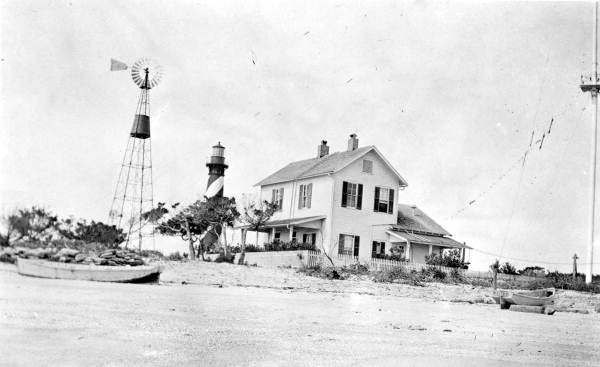
St. Augustine Lighthouse
Photograph courtesy State Archives of Florida
The head keeper lived in the north side of the new dwelling, with the first assistant in the south side and the second assistant making do with two small rooms located on the top floor between the two sides. The keeper’s bedrooms were located upstairs, while downstairs each side had a dining room on the west and a parlor on the east side.
Constructing the new lighthouse proved to be a prudent move as the old tower toppled into the sea on August 22, 1880.
With three keepers stationed at the lighthouse, the day was divided into three eight-hour watches. The primary responsibility of the keepers was to care for the light, which required lugging a thirty-pound can of lard oil up the tower’s 214 stairs and periodically winding up the 275-pound weight that revolved the lens. In addition, the keepers maintained all the station’s buildings, provided tours to visitors, and when necessary even served as lifesavers. This latter function is demonstrated by the following two entries from the station’s logbook:
September 23, 1887 Schooner Dream went on sand bar near old lighthouse at 3 AM. Nine passengers rescued by keepers. Lost anchor, sails, and small boat. Vessel floated off in damaged condition.
November 13, 1890 At 5 PM, the steamer Star Spangled Banner foundered on the bar. A total wreck. Crew were rescued by keeper.
The effects of the powerful earthquake that rocked Charleston, South Carolina on August 31, 1886 were felt by at St. Augustine by Keeper William A. Harn, who provided the following description of the event:
Just preceding the shock was a noise like a strong wind. The first impression of every one was that a squall had arisen, until looking out it was found to be perfectly calm; scarcely a breath of wind was blowing. The movement was from southeast to northwest ; the shocks were felt by all persons residing on the island. The windows and doors rattled loudly and bird-cages swung violently. The motion was undulatory. Just before the shock the chickens cackled as if disturbed, and just after the first shock all the dogs in the vicinity of the station barked in an alarmed manner. The sky was clear and the stars were shining brightly. The sea was very quiet. Several persons were made sick by the motion of the earth.
In 1888, brick kitchens, measuring fourteen by sixteen feet, were built on either side of the keepers dwelling to replace two unsightly frame structures.
Life at the station was full of varied activities for the keeper’s children. One noted story involves Cardell "Cracker" Daniels, son of Keeper Cardell D. Daniels. Cracker would regularly use the tall tower in his backyard as a launching pad for his model airplanes and parachutes. After safely parachuting several inanimate objects off the tower, Cracker decided it was time for a live experiment. Cracker’s sister, Wilma, had a cat named Smokey, who was selected as the paratrooper. After a couple of practice descents from lesser heights, the reluctant cat was tossed from the top of the tower with the parachute strapped to its back. When the frightened feline reached the ground, it quickly fled from the area. Unaware of Cracker’s antics, Wilma searched far and near for her cat over the next several days. A month passed before Smokey finally returned home, but it wasn’t until several years later that the family learned the reason for the cat’s disappearance.
The keeper’s dwelling was electrified in 1925, but the tower was not wired up until 1936. Electricity lessened the keeper’s responsibilities, eventually leading to the de-staffing of the lighthouse in 1955. Local lamplighters were subsequently employed to polish the lens and switch the light on and off, and the dwelling was rented out for several years. David Swain, a former assistant keeper at the lighthouse, filled this role from 1956 to 1968. Full automation of the light occurred around 1971, when a sun relay was installed atop the tower to activate and deactivate the light.
In the late 1960s, the dwelling was boarded up, declared surplus, and put on the auction block. St. Johns County was negotiating the purchase of the dwelling when it was completely gutted by an arson’s fire on July 28, 1970. The fire did reduce the purchase price, but made restoring the structure a daunting task. The county considered tearing down the dwelling, but the Junior Service League of St. Augustine, founded in 1935 by a group of women interested in improving social, educational, and cultural conditions of St. Johns County, offered to take on the restoration project in 1980. Eight years later, the dwelling was opened as a maritime museum. In 1990, the Junior Service League signed a lease with the Coast Guard for the lighthouse, and the following year the tower, equipped with safety features, was opened to the public for climbing.
In 1986, bullets shot from a .30-06 rifle shattered nineteen prisms in the historic Fresnel lens. Hank Mears, who served as caretaker of the light from 1968 to 1989, called the FBI, and the ensuing investigation found powder burns on a nearby palm tree. The FBI found the fourteen-year-old responsible for the shooting, but the senseless act led to the lens being taken out of commission in September 1991. An airport beacon was placed atop the tower, while the options of removing the lens or repairing it were debated. Fortunately, a grant was obtained, replacement prisms and a bull's-eye panel were recreated, and the lens resumed operation on May 22, 1993.

The St. Augustine Lighthouse & Museum was incorporated as a separate entity from the Junior Service League in January 1998, and a new visitors’ center was added to the site in 2000 to help accommodate the large crowds who come to learn about the lighthouse and to climb to the top of the tower for the expansive view. The lighthouse was awarded to St. Augustine Lighthouse and Museum in 2002 under the provisions of the National Historic Lighthouse Preservation Act of 2000.