Showing posts with label Virginia. Show all posts

Saturday, March 8, 2014

Old Cape Henry Lighthouse Cape Henry Virginia

A 2Fer at Cape Henry...


The old masonry light at Cape Henry was a long time coming. For seventy years, the Colonial Assembly of Virginia heed and hawed, passing resolutions and attempting to convince reluctant authorities in Maryland and Great Britain to assist in the construction of a beacon at this vital cape. Standing at the juncture of Chesapeake Bay and the Atlantic Ocean, Cape Henry is the entry point to the ports of Norfolk, Newport News, Baltimore and Washington, D.C.
For many years preceding the birth of our nation, pirates were far more appreciative of the importance of Cape Henry than was the Virginia House of Burgesses. With the cape lacking a proper light, beacon fires were used as a makeshift navigational aid, and unscrupulous men would capture those in charge of the fires and move the light southward to lure ships aground. As the wreckage continued to mount, men like Virginia Governor Alexander Spotswood petitioned the Assembly to take action. In 1720 this body resolved to construct the light, “Provided the Province of Maryland will contribute...”
Receiving little but passive cooperation from their neighbors, the Virginia Assembly was further hampered by the reluctance of the British Board of Trade to grants its permission to proceed. Since the lighthouse was to be financed in part by shipping duties, the consent of this august body was required. Governor Spotswood argued a strong case, describing the plight of merchants too frightened to venture into the Chesapeake during foul weather. He reasoned: “If such a lighthouse were built ships might then boldly venture, there being water enough and a good channell within little more than a musquett shote of the place where this lighthouse may be placed.” Yet it was only in 1758, and at the behest of concerned tobacco merchants, that the Board threw their weight behind the project.
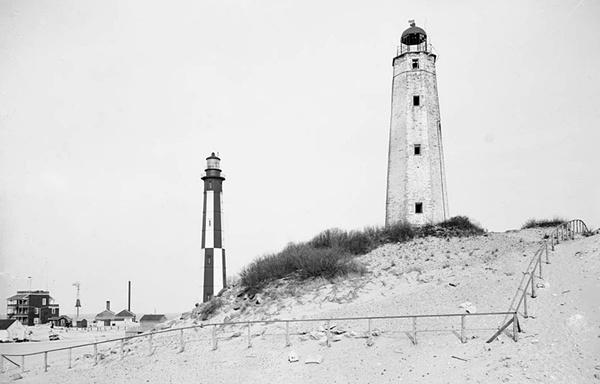
New and Old Cape Henry Lighthouses in 1905
Photograph courtesy Library of Congress
In 1772, the Maryland assembly got on board as well, and the project was underway. Workers’ quarters and stables were built and over 4,000 tons of stone were delivered to Cape Henry. In the summer of 1775, however, the initial allotment of funds was nearly depleted and an additional 5,000 pounds was requested. At this point, the Revolutionary War intervened, and the valuable stones lay forgotten and buried in drifts of sand while more pressing matters were attended to.
In many respects, Old Cape Henry lighthouse is inextricably linked with the birth of our nation. The Aquia sandstone for its base was gathered from the same Virginia quarries that provided material for Mount Vernon, the U.S. Capitol Building, and the White House. At the first session of the first Congress in 1789, an act was passed which placed the lighthouse service under the jurisdiction of the Department of the Treasury. Included in this act was the provision for the construction of Cape Henry Lighthouse, giving it the distinction of being the first lighthouse ordered and financed by the federal government. The Virginia Assembly, mindful of its own difficulties in building the lighthouse, moved rapidly and ceded two acres in the County of Princess Anne to the United States. President Washington himself took an interest in the construction, noting in a 1790 diary entry that he had spoken with Alexander Hamilton (the Secretary of the Treasury), “respecting the appointment of Superintendents of the Light House, Buoys, etc, and for building one at Cape Henry.”
Secretary Hamilton contracted with a New York bricklayer named John McComb, Jr. to undertake the project at a cost of $15,200. The contract called for McComb, with “all convenient speed, (to) build and finish in a good workman like manner a Light House of Stone, Faced with hewn or hammer dressed Stone...from the bottom of the Water Table up to the top of the Stone Work.” The contract also specified a two-story frame house of twenty feet square, for the keeper, as well as a buried vault for the storage of lamp oil.
The construction proved to be a difficult task, though Hamilton’s representative on the scene describes a highly motivated and uncomplaining John McComb: “He is persevering and merits much for his industry, the drifting of the sand is truly vexatious, for in an instant there came down fifty cart loads at least, in the foundation after it was cleaned for laying the stone, which he bore with great patience and immediately set to work and removed it without a murmur as to the payment for the additional work...” The builder did have to be compensated an additional $2,500, however, as the foundation had to be laid at a depth of twenty feet rather than the planned thirteen, owing to the sandy condition of the ground. McComb estimated that he would finish the lighthouse by October 1792, and this is indeed when it was first lighted.
Lemuel Cornick, who had overseen the construction of the lighthouse, applied to be its first keeper, but President George Washington awarded this honor to William Lewis, who had been one of his loyal troops during the Revolutionary War. Keeper Lewis died just a month after his appointment, and Lemuel Cornick got his chance to run the light. Though he had desired the position, Cornick abandoned the job less than a year later, and Laban Goffigan was made the light’s third keeper.
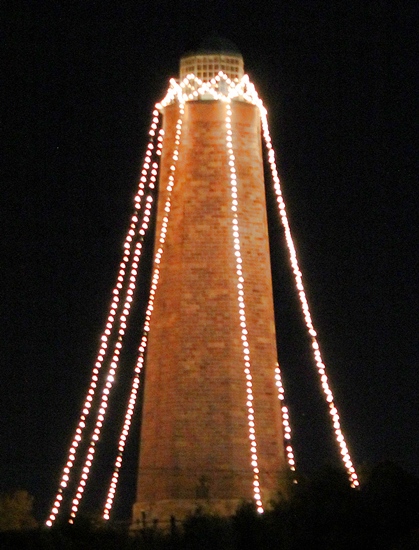
Old Cape Henry decorated for the holidays
Photograph courtesy Stuart Nesbit
Engineer Benjamin Latrobe visited Cape Henry in 1798 and provided detailed descriptions and sketches of the light in operation. One of his drawings shows Old Cape Henry complete with the weather vane, ventilator, and lightning rods called for in the contract with McComb. Latrobe described the lighthouse as “an octangular truncated pyramid of eight sides, rising 90 feet to the light...and six or seven hundred yards from the beach...” This design is basically the same as that of the Cape Henlopen, Delaware tower constructed in 1767. The tower is twenty-six feet in diameter at its base, and the walls there are six feet thick. At its summit, it shrinks to a diameter of sixteen feet. The tower is composed of attractive rosy Rappahannock sandstone which caught Latrobe’s fancy, although he did find fault with the structure on two key points. First he decried “the unpardonable fault of a wooden staircase, which being necessarily soaked with oil exposes the light to the perpetual risk of destruction of fire.” He also sympathized with the plight of the keeper, noticing that the lighthouse, which sits at the summit of a fifty-six-foot-high sandy dune, creates a whirlwind about it which “licks up the sand...and heaps it around in the form of a basin. The sandy rim, while it protects the keeper from the storms, renders his habitation one of the dreariest abodes imaginable.”
Like most of its comrades, the light at Cape Henry underwent numerous repairs and technological upgrades in the ensuing years. In 1835, a new house was built for the keeper, and in 1841, the lantern was completely redone by Winslow Lewis with eighteen new lamps with brass burners and eighteen reflectors. This work was performed at a cost of $4,000 and included replacement of the wooden deck near the summit with a soapstone deck laid over a brick arch. In 1844, a fifteen-foot-high wall was built around the tower’s base and that area was paved over. In 1855, a fog bell tower was added, and in 1857, the tower was lined with brick and a second-order Fresnel lens replaced the array of lamps and reflectors. Other innovations included the types of oil used in the lantern; these varied from whale oil to cabbage, lard, and kerosene oil, which was adopted near the turn of the century.
The Civil War temporarily put Cape Henry out of commission. In April 1861, men from Princes Anne County seized the tower and destroyed the lamps and lens. It is likely that the Confederate states (including Virginia) feared the formidable sea power of the Union and sought to make it difficult for them to enter the vital Chesapeake. A lightship was anchored off the cape to serve Union forces until 1863, when Cape Henry Lighthouse was repaired, put back in operation, and placed under military guard.
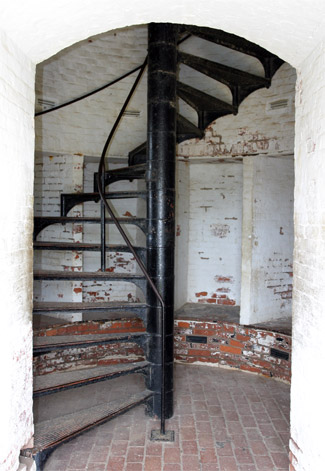
In 1864, an inspector finally corroborated Latrobe’s observation, remarking that Cape Henry was endangered by its oil soaked wooden staircase, which was at this point “greatly decayed and insecure.” The inspector recommended a cast-iron spiral staircase, and this was subsequently installed. The tower remained strong for eight more years, but in 1872 the district engineer noticed large cracks “extending from the base upward” on six of the eight masonry walls comprising the octagonal structure. The inspector concluded that some of these cracks were inconsequential, but those on the north and south faces were compounded by the presence of windows. The inspector concluded that the tower was unsafe and “in danger of being thrown down by some heavy gale.” The construction of a new first-order lighthouse and keeper’s dwelling was recommended, but it took six years for the necessary $75,000 to be appropriated. In 1881, Keeper Jay Edwards transferred his attentions to the new cast-iron structure. Standing 350 feet southeast from the old tower, it was first lighted on December 15, 1881.
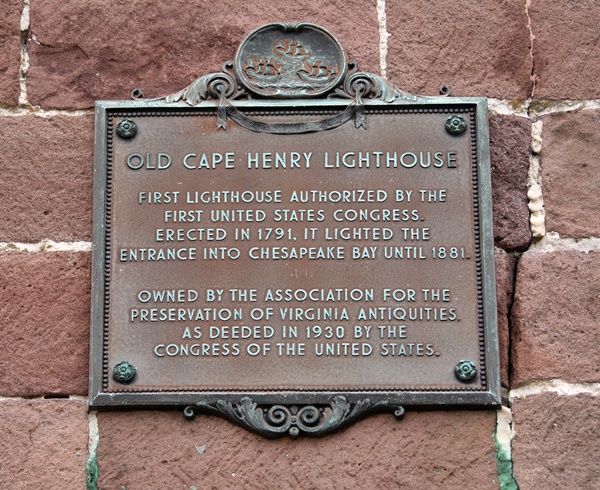
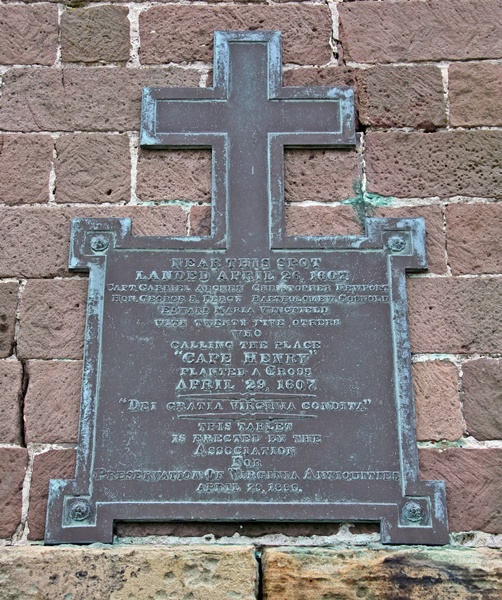
Somewhat surprisingly, Old Cape Henry lighthouse has neither crumbled nor been swept away in a storm. Today it stands in silent idleness, next to and somewhat higher than its replacement, owing to its location on the summit of the dune. It remains an indelible landmark, and in 1896 was graced with the presence of the members of the Association for the Preservation of Virginia Antiquities (APVA). They placed upon the old light a plaque commemorating it as the site of the first landing in 1607 of English colonists on Virginia soil. It thereby became the predecessor of the Cape Henry Memorial, to which its shadow reaches on a late summer afternoon. On June 18, 1930, the U.S. Congress ceded the light and land to the APVA, to be preserved in perpetuity as an historic landmark.

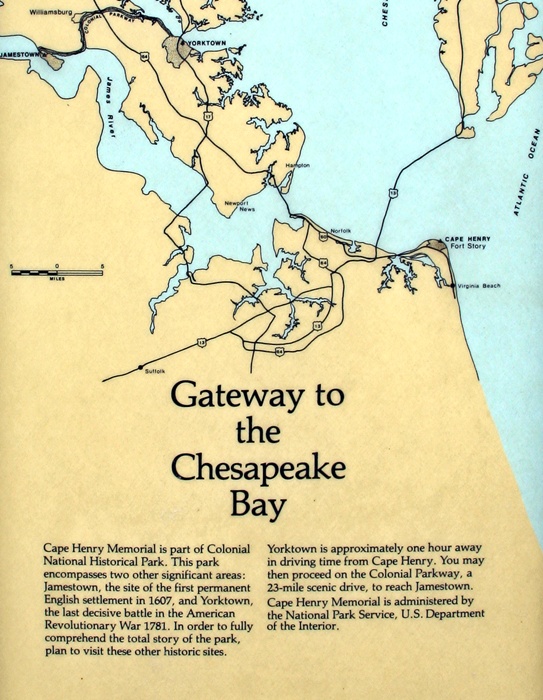
In 1939, Old Cape Henry Lighthouse was selected as the site to celebrate 150 years of the Lighthouse Service, and it was this same year that lighthouse maintenance was transferred from the Treasury Department to the Coast Guard. Today, the lighthouse grounds are encompassed by Fort Story Military Reservation and are a noteworthy destination for visitors to the nearby Colonial National Historic Park. Old Cape Henry is the fourth oldest lighthouse still standing in the United States. The lighthouse was declared a National Historic Landmark in 1964 and a National Historic Civil Engineering Landmark in 2002.

New Cape Henry Lighthouse Cape Henry, Virginia

Got this on the way home from Maine in 2012.  


During an inspection of Cape Henry Lighthouse in 1872, troubling structural damage was noted. The inspector found “large cracks or openings, extending from the base upward,” on six of its eight walls. “Four of these,” he reported, “are apparently less dangerous than the other two, and alone would not warrant any great apprehension of danger, but the latter, those on the north and south faces, where the strength of the masonry is lessened by openings for windows, are very bad, extending from the base almost to the top of the tower.” A new dwelling and first-order lighthouse were recommended as the existing tower was “in danger of being thrown down by some heavy gale.”
New Cape Henry Lighthouse and Old Cape Henry minus its lantern room
Photograph courtesy U.S. Coast Guard
A similar warning was repeated each of the following years until Congress finally granted an appropriation of $75,000 in June 1878 to replace Cape Henry Lighthouse. With funds finally in hand, the Lighthouse Board proved itself more than eager to begin the project. In its 1879 annual report, the board enthusiastically reported: “The drawings and specifications for a new 1st-order light house are now completed and ready for distribution to bidders.” Negotiations for six acres of land were also underway, and the search was on for contractors to complete the metalwork. As this new light was to be composed of enormous cast-iron plates bolted together, this was a tall order indeed (the tallest cast-iron, fully enclosed lighthouse in the United States, in fact). The board was emphatic that “no unnecessary delay will be made in the prosecution of this important work,” and they requested $25,000 more in funds to move the project along.
In 1880, the Lighthouse Board insisted that steady progress was being made, in spite of delays in the metal work and land negotiations: “...about one third of the wrought iron work has been completed. The base section, comprising about 16 feet in height of the tower, is nearly completed.” An 1880 photograph shows construction materials strewn around a base section just starting to emerge from the sand, with the reliable old stone tower standing staunchly in the background.
A pier was completed near the construction site in August 1880, and soon thereafter “the broken stone for concrete, the hoisting-engines and steam concrete-mixer, 600 barrels of imperial Portland cement, brick for the fog-signal building and the fog-siren machinery, with the exception of the boilers, were landed.” After enduring these tons of bricks and machines, the pier proved too fragile for a load of tower ironwork, and the bridge leading from the loading dock to the shore broke under the strain of a fully loaded car. The remainder of the off-loaded ironwork was transported to Norfolk by a hastily procured schooner and placed in storage. Just hours after the load was removed, the pier collapsed entirely.
The failure was not totally the fault of the pier-builder; examination of the wood revealed that a boring worm had devoured much of the structure, weakening it considerably. The Lighthouse Board decided that rather than rebuild the pier a tramway would be extended four miles to Lynnhaven Inlet, where scows (flat bottomed freight boats) would be used to land construction materials.
When work was suspended for the winter in November 1880, a brick fog signal building, covered by a corrugated iron roof, had been completed, and one worker remained behind to watch over the property and supplies. The first-class steam siren housed in the fog signal building commenced operation on December 1, 1880.
Work on the lighthouse resumed on May 30, 1881 and progressed smoothly from this point forward. By mid-June the extensive preparatory work had been completed; this included relaying portions of the tramway that had washed out and “putting hoisting engines in order, erecting derricks and preparing cars for hauling.” The remaining metal plates, their completion long delayed by inept contractors, were finally ready to be shipped from their foundries in mid-July, and a first-order Fresnel lens was awaiting shipment from the Staten Island depot to Virginia.
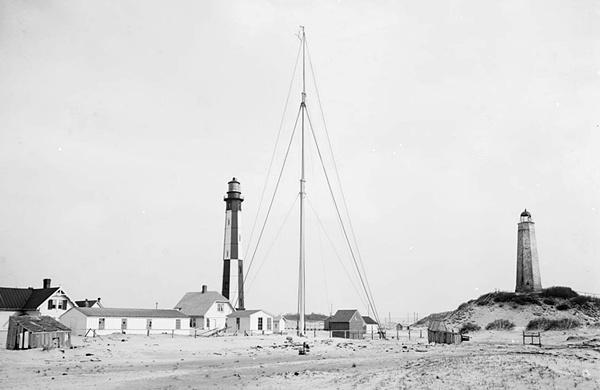
New and Old Cape Henry Lighthouses in 1905
Photograph courtesy Library of Congress
A course of cut granite was laid atop a massive concrete foundation to serve as the base for the ironwork. Having been marked in the foundry, the massive iron pieces were quickly set in place in the tower – the bottom section of the tower was commenced on July 8, and the sixth and final section was in position on September 8. During the remainder of September, the service and watch rooms were completed, and the interior of the tower, consisting of the stairway, landings, and lining, was finished on November 15. The first-order lens was tested on November 27 and “found to work admirably.” Freshly painted, the lighthouse was officially turned over to Keeper Jay Edwards on December 15, 1881 and placed in operation that evening with its light shining at a focal plane of 157 feet and visible for up to 18 ¾ miles. In just one day, the old tower, which was left standing as a daymark and as a basis for coast survey triangulation, transitioned from a lighthouse to a historic landmark.
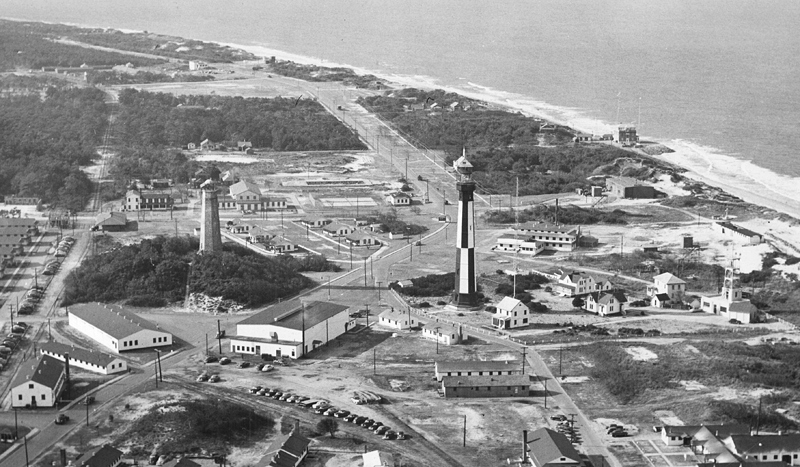
The two towers continue to stand side-by-side on the southerly Cape of Chesapeake Bay, one of the most important shipping channels in the nation. The vital ports of Norfolk, Newport News, Baltimore and Washington are all accessed through the Chesapeake, and the Cape Henry lighthouses have provided over two hundred years of uninterrupted aid to navigation.
New Cape Henry Lighthouse is adorned with one of the most distinctive daymarks to be found on a lighthouse anywhere in the world. Its stark octagonal tower alternates between white and black on its various faces, and midway up this pattern is offset by one face, producing a checkerboard-like effect. The unique coloring distinguishes Cape Henry from the all-white tower of Cape Charles to the North and the redbrick tower at Currituck Beach to the South.
In July 1887, a system of magneto-electric call bells with an arranged code of signals was installed at the station to connect the tower, fog signal building, and dwellings, and in April 1888, a 79° red sector was placed in the lens to cover dangerous shoals at the entrance to the bay. In 1892, a brick oil house, capable of storing 500 five-gallon oil cans was erected near the lighthouse along with a summer kitchen.
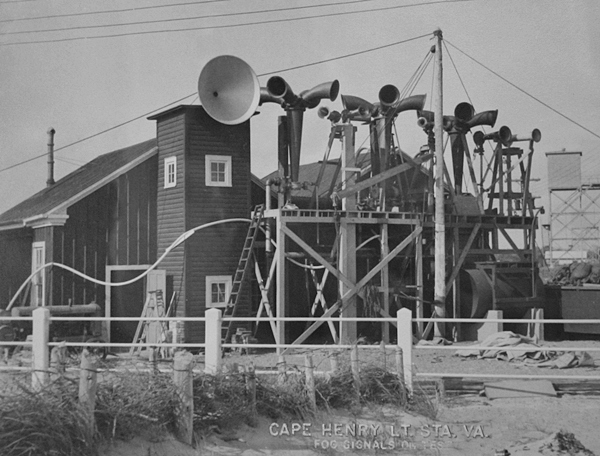
Cape Henry's Fog Signal Testing Station
Photograph courtesy National Archives
Milton L. Odell replaced Jay Edwards as keeper of the new lighthouse in 1885, and it wasn’t long before he was embroiled in controversy. Charges of “neglect of duty, misappropriation of government property, and of offensive partisanship” brought against Odell were disproved before the Lighthouse Board, but the men who sought Odell’s job didn’t stop there. As Keeper Odell was returning to the lighthouse on horseback in December 1887 after being on sick leave in Norfolk, he was fired upon by three men. The keeper returned fire after recovering from the initial shock of the attack and believed he must have hit one of the assailants as he heard a cry of pain. As proof of the attack, Keeper Odell was left with two bullet holes in his gum coat.
During the twentieth century, Cape Henry Lighthouse saw many technological upgrades that have accumulated to make it the very modern aid to navigation station that it is today. In 1912, an incandescent oil-vapor lamp replaced a lamp with five concentric oil-burning wicks, and ten years later, the light was converted to electricity and its characteristic changed from fixed white to a group of three flashes every twenty seconds. At the time of electrification of the light, experiments were conducted at Cape Henry to determine what type of bulb and how many were needed, as it was feared that a single electric bulb would not provide sufficient light to reach all the prisms of the lens.
A radiobeacon was placed in commission at Cape Henry on June 1, 1923, making it one of the first lighthouses in the United States to deploy such a device. After an electrically operated oscillator replaced the first-class siren, it was possible to conveniently synchronize the fog signal and radiobeacon, and on February 26, 1929, a distance-finding test was conducted off Cape Henry and found that by noting the difference in time between the reception of the radio signal and the audible fog signal a vessel could determine its distance from the lighthouse with sufficient accuracy for navigation. The setup was officially commissioned on May 23, 1929 as the country's first synchronized distance-finding system.
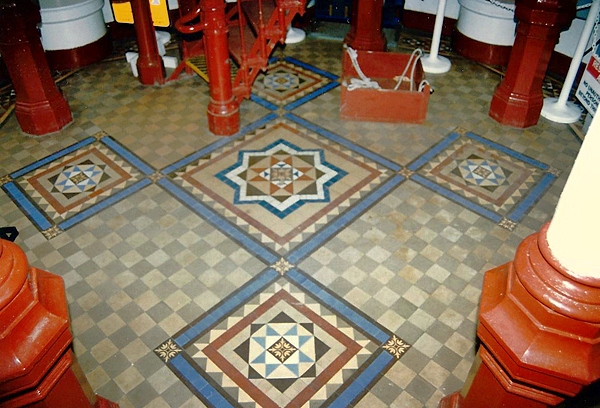
Beautiful tile floor inside lighthouse
Photograph courtesy Al Smith
Cape Henry became home in 1934 to a fog signal testing laboratory, where investigations were conducted for the benefit of the entire Lighthouse Service. Indeed the station has been of great scientific importance, as experiments in radar and wind-generated electricity were also conducted there. In 1996, Cape Henry leaped into the twenty-first century when a Differential Global Positioning System was installed.
Since 1984, Cape Henry Lighthouse has been fully automated, rendering the presence of a keeper unnecessary. Budget restrictions have forced the U.S. Coast Guard to examine the “prohibitive costs of maintaining the historical integrity of the structure.” The Coast Guard is responsible for 50,000 aids to navigation, only about 500 of which are lighthouses. In a memo from the late 1980s, the commander of the Fifth Coast Guard District defended his decision to continue maintenance of New Cape Henry Lighthouse: “You...recommended that we excess the structure and... build a skeleton tower for the required optic. … As the program manager, it is my decision to retain this lighthouse as one of the major landfall aids for the Chesapeake Bay entrance. A skeleton tower would not present the same visual daymark as the current 165-foot tower."

Some within the Coast Guard proposed demolishing the tower, hoping that a historical society would then step in to save the lighthouse. Even without the threat of demolition, it seems this goal just might be achieved. In 2005, Virginia’s most experienced historic preservation organization, the Association for the Preservation of Virginia Antiquities (APVA), requested control of the lighthouse from the Coast Guard. APVA already runs the old lighthouse just 100 yards away, and if successful in obtaining the new one, they plan to open the iron tower for climbing, and the associated two keeper’s quarters for tours. Cape Henry would certainly become one of the top lighthouse destinations if this occurs.

Thursday, March 6, 2014

Old Point Comfort Light Virginia


Got here during the summer 2012 trip 


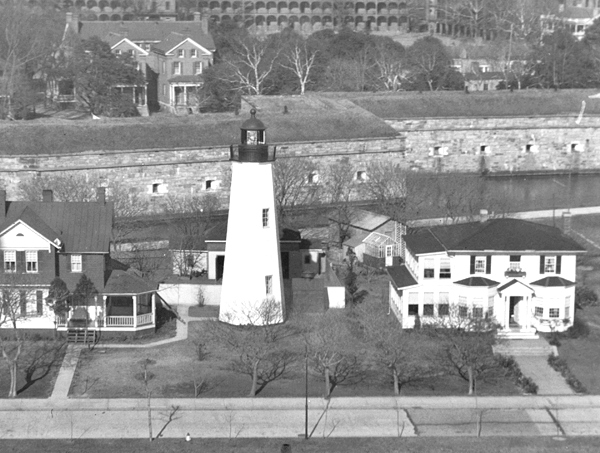
Old Point Comfort Lighthouse marks the entrance to historic Hampton Roads, a substantial harbor situated at the mouths of the James, Nansemond and Elizabeth Rivers, and stands on ground which has seen many a fort constructed nearby to defend this important waterway. The tower’s present neighbor, the Civil-War era Fort Monroe, was preceded by colonial Fort George, which in turn was probably preceded by an even earlier fortification. A navigational beacon on Old Point Comfort was active as early as 1775 when John Dams, caretaker of the ruins at Fort George, was paid an annual supplement of 20 pounds to tend a light there. Some historians believe that Native Americans kept wood fires burning at the Point before that for the benefit of Spanish ships during the 16th century.
Old Point Comfort Lighthouse in 1885. Note bell tower and previous dwelling.
Photograph courtesy National Archives
With the establishment of the United States government and its ensuing lighthouse projects at places like Cape Henry, pressure mounted to build a permanent aid to navigation at Old Point Comfort. An early edition of the American Coast Pilot noted the 1798 law passed by the U.S. Congress that set aside $3,050 for a light at Old Point Comfort and proclaimed: “We wish, for the security of navigation, that the important work may soon be undertaken, for the safety of our mariners.” Between 1800 and 1801, Congress appropriated another $5,000 for construction costs, and contracted the services of Elzy Burroughs to complete the octagonal stone structure.
Burroughs completed most of the work on the lighthouse, which stands fifty-four feet high, during 1803. The tower possesses a spiral staircase composed of hand-cut stone, stacked strategically on top of each other. The stairs lead to a ladder that ascends to a trap door, beyond which is the lantern room. Ten oil lanterns, which consumed 486 gallons of oil each year, were set in reflectors to produce a light that could be seen from fourteen miles at sea.
During the War of 1812, the lighthouse temporarily fell into British hands, when the Jack Tars and Royal Marines sailed into the Chesapeake. Frustrated in their efforts to seize the town of Norfolk, the invaders landed at Old Point Comfort and used the tower as an observation post. From there they went on to take and burn Hampton on June 25, 1813, and then torch Washington D.C. a few weeks later on August 14th.
After the war, Old Point Comfort was vastly transformed by both the federal government and private investors. The government erected Forts Monroe and Calhoun, the former on shore and the latter on a man-made island called ‘Rip Raps’ situated in the middle of Hampton Roads. The clever Robert E. Lee, Lieutenant of Engineers, was transferred to Fort Monroe in 1831 and was instrumental during the next three years in helping complete construction on Fort Monroe, which is the largest stone fort ever built in the United States . Entrepreneurs built a few resort hotels and otherwise transformed the area into a vacationer’s paradise for the leading lights of a young American society.
On March 3, 1837, Congress appropriated $6,000 to move Old Point Comfort Lighthouse inside Fort Monroe, but at the last minute the work was deferred, and the tower remains outside the fortress to this day. A fourth-order, Henry-Lepaute Fresnel lens replaced the array of lamps and reflectors in 1854, reducing the consumption of oil to just one-tenth the former amount while producing a “light of much greater power and brilliancy.”
On July 20, 1855, the lighthouse received a companion structure – a fog bell mounted on a wooden tower to help guide mariners during periods of reduced visibility. The bronze bell was forty inches around and three feet high, and its ringing could be heard up to three miles away. Also that year, a sixth-order beacon light was added to the station to guide ships to anchorage inside Hampton bar, but this light was discontinued in 1869, being no longer of any service to navigation
Aerial view of lighthouse in 1925
Photograph courtesy U.S. Coast Guard
While most east coast lighthouses were damaged, destroyed or at least put out of commission during the Civil War, the tower at Old Point Comfort was undisturbed during the conflict as Fort Monroe remained under Union control throughout the war. An observer perched on the lighthouse’s deck would have seen an impressive procession of historic events during the conflict. President Lincoln landed at the fort’s wharf in 1862 so he could witness Union troops take Norfolk. The legendary battle of the first ironclads, the USS Monitor and the CSS Virginia, occurred just offshore in Hampton Roads, and finally, at the end of the war, Confederate President Jefferson Davis was imprisoned in an artillery room near the light station.
Shortly after the start of the Civil War, William Davis escaped from a plantation in Hampton and then rescued his mother, wife, and seven children from other plantations and sought asylum with them inside the walls of Fort Monroe. Old Point Comfort was no stranger to slaves, as it was here in 1619 that the first “20 Negars” in North America were unloaded and traded for food. The Union army enlisted numerous African American troops from those former slaves who sought refuge at the fort.
William Davis was appointed keeper of Old Point Comfort Lighthouse in 1870 and served in this capacity for eight years until being replaced in 1878 by John Jones, also a former slave, whose tenure of thirty years as keeper of the lighthouse was the longest. On the night of August 31, 1886, Keeper Jones noted that his clock stopped at 9:55 p.m., when the station experienced the effects of the major earthquake centered at Charleston, South Carolina. According to Jones, the shocks felt at Old Point Comfort lasted about two minutes and were accompanied by a rumbling noise.
In 1891, a new keeper’s house was built just south of the lighthouse to replace existing dwelling, which was “old and beyond economical repair.” The dwelling was connected to the fort’s water supply in 1893, and a new oil house and an iron bell tower were added to the station in 1896. Sixty running feet of four-inch sewer pipe was laid in 1901, and the resulting dug-up grounds were substantially re-landscaped with sixty-three assorted plants and eight packets of flower seeds. Keeper Jones was provided a lawn mower and 150 feet of garden hose to help him keep the grounds neatly manicured.
Improvements to the station continued to be made in the new century. An electrical fog bell striker replaced the station’s mechanical striking mechanism in 1917, and the following year the illuminant used in the lighthouse was changed from oil to incandescent electric, which increased the light’s intensity. With advances in aeronautics the station was designated an aerial landmark. The roof of one of the station’s buildings was painted in a distinctive pattern and became part of a chain enabling pilots to find their way from Washington D.C. to Norfolk. In 1936, an experimental apparatus was added to control the fog bell. A beam of light was fired every two minutes from nearby Fort Wool onto a photoelectric cell at Old Point Comfort. If the beam failed to arrive, that meant it had been impeded by rain, fog, or snow, and the fog bell was activated.
Old Point Comfort Lighthouse in 1988
Photograph courtesy Library of Congress
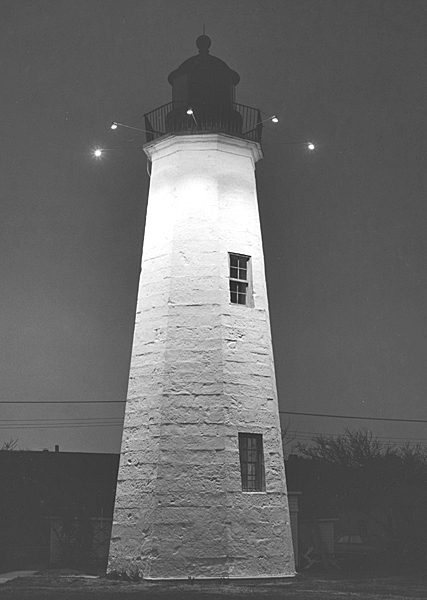
The problem of competing coastal lights from hotels and attractions was tackled in an innovative manner in 1954, when a Coast Guard officer in charge of the lighthouse attached 250 watt bulbs to the end of five poles extending from the balustrade encircling the lantern room, so that they resembled spokes on a wheel. While this may have made the lighthouse more distinctive, one writer lamented that “it made the light look like an amusement park ride...rather than a noble lighthouse.”
Over the years, the characteristic of Old Point Comfort Lighthouse was altered several times. Originally fixed white, the light was changed to fixed red around 1900, and then in 1905 a white sector was used for a short time before the signature was changed back to fixed red through the entire arc of visibility. For many years now, the automated signal has shown a mixture of red and white light, with the white sector covering an arc of 133°. The pattern is arranged so that if a vessel sees red, its crew knows it is on a dangerous course.
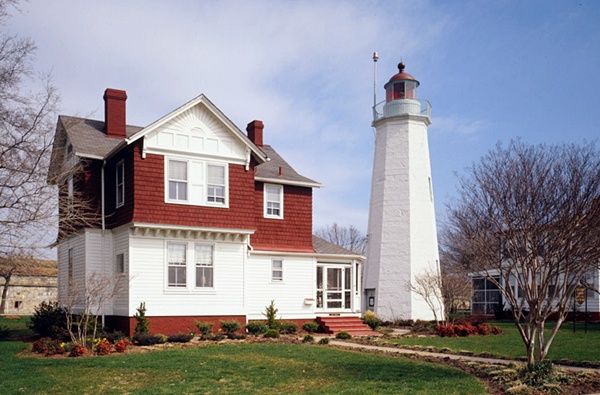
Today the lighthouse tower is a freshly painted white, topped by a dull red, domed copper roof and a lightning rod. The structure has four large double-pane windows, with bright green sashes and frames. The ‘eye-catching’ green was rumored to be a contractual error that would soon be corrected, but it has remained for years. A solid steel door guards the base of the lighthouse, alongside a plaque denoting it as a Virginia National Landmark.
The keeper’s dwelling housed the families of two Coast Guardsmen until automation in 1973; presently it is the house of an Army Major. The house was described in an inventory of the station produced by the Army as stylistically eclectic, exhibiting “influences from the Shingle Style of the 1870's, the Stick Style of the 1870's, a touch of Queen Anne, and a soupçon of Eastlake.”
Old Point Comfort Lighthouse has been privy to events of great military importance since the War of 1812. In 1907 Teddy Roosevelt’s ‘Great White Fleet’ set sail from nearby Hampton Roads for its cruise around the world, and on November 14, 1910, the first launching of a plane from a warship took place on the deck of the USS Birmingham in Hampton Roads. Today, the historic lighthouse still watches over the busy waterway frequented by vessels ranging from personal watercraft to aircraft carriers. 

Thursday, February 20, 2014

Assateague Light, Chincoteague National Wildlife Preserve, Virginia


                        Assateague Light


AssateagueLighthouse.jpg
Assateague Lighthouse, Aug 2007
Locationsouth of Chincoteague, Virginia
Coordinates37°54′40″N 75°21′21″W / 37.9111°N 75.3558°W / 37.9111; -75.3558
Year first lit1867
Automated1933
DeactivatedN/A
FoundationStone & Concrete
ConstructionRed Brick
Tower shapeConical
Height142 ft
Original lensfirst-order Fresnel Len
Range19 miles
CharacteristicDouble-flash every five seconds
Assateague Lighthouse
Nearest cityChincoteague, Virginia
Area9.9 acres (4.0 ha)
Built1867
Governing bodyFederal
NRHP Reference #73001989[1]
VLR #160-0020
Significant dates
Added to NRHPJune 4, 1973
Designated VLRDecember 16, 1980[2]
Assateague Light is the 142-foot-tall (43 m) lighthouse located on the southern end of Assateague Island off the coast of the Virginia Eastern Shore, USA. The lighthouse is located within the Chincoteague National Wildlife Refuge and can be accessed by road from Chincoteague Island over the Assateague Channel. It is owned by the U.S. Fish and Wildlife Service and operated by the U.S. Coast Guard and is still used as an active aid in navigation. The keeper's quarters are used as seasonal housing for refuge temporary employees, volunteers, and interns. Constructed in 1867 to replace a shorter lighthouse (45-feet-tall) built in 1833, the lighthouse is conical in shape and is painted in alternating bands of red and white.