Showing posts with label New York. Show all posts

Saturday, March 8, 2014

Fort Niagara Lighthouse Buffalo New York

This is a beautiful light at Fort Niagara, right on the lake north of Buffalo-  there this summer 2013. 


Several lighthouses have marked the point where the Niagara River joins Lake Ontario near Youngstown, New York. This area attained importance in the late 1600s when French fur traders used the Great Lakes to transport their goods. Niagara Falls separated the supply of furs to the west with the demand that lay to the east, forcing the traders to use bateau (flat-bottomed, shallow-draft boats) and canoes to portage furs around the falls. The mouth of the Niagara River became an ideal point for transferring the furs to larger ships, and since that time, it has served as an essential harbor as well as a point of strategic importance during multiple wars.
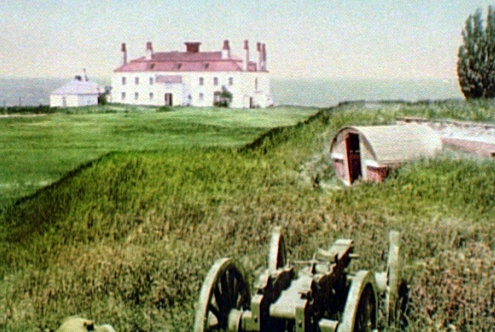
A predecessor to the current Fort Niagara was built in 1679 by the French and was named Fort Conti and then Fort Denoncille. In 1726, the still-standing “French Castle” was built, intended as a gathering place where colonists could find protection from hostile Native American tribes. At this time, the fort and vapor of Niagara Falls served as useful navigational markers during the day, but at night mariners lacked any sort of guide.
Fort Niagara circa 1900 with possible remains of tower
Photograph courtesy Library of Congress
In 1759, the British captured Fort Niagara after a nineteen-day siege that was part of the French and Indian War. Due to the increase in vessels on the Great Lakes after this conflict, the British placed a beacon on the roof of the fort in 1781. This was the first unofficial lighthouse on the Great Lakes, and like most of its contemporaries, it was probably illuminated with whale oil. The light's primary purpose was to keep vessels from drifting too far west of the fort at night.
Fort Niagara was relinquished to the United States in 1796 after the Revolutionary War, and the roof light remained active until 1803. The British garrison across the river at Fort George constructed the Newark Light in 1804, the second lighthouse to serve the area. This lighthouse survived the War of 1812, but in 1814, it was demolished to clear a site for the construction of Fort Mississauga. The next light to mark the mouth of the river was established in 1823, after Congress provided $1,000 on May 7, 1822 for “placing a lamp on the mess-house at Fort Niagara” and $1,500 on March 3, 1823 for “completing a tower for the light on Fort Niagara.” Vessel traffic in the area declined after the opening of the Erie Canal in 1825 reduced the need for the difficult Niagara portage.
Fort Niagara and its lighthouse were involved in the William Morgan affair, an 1820s political scandal. Morgan, a renegade Freemason who threatened to go public with obscure Masonic rituals, was kidnapped and held at Fort Niagara shortly before his disappearance in 1826. Edward Giddings, keeper of the lighthouse at the time, was suspected of having been involved in the detainment of Morgan at the fort, but no one was ever punished for his death. The incident caused a national sensation over dark Masonic conspiracies, leading to the creation of a short-lived anti-Masonic political party.
In 1829, the Canadians opened the privately-financed Welland Canal, which provided a navigable link between Lake Ontario and Lake Erie and eliminated the need to haul vessels overland. Despite this improvement, enough sailing and steam vessels remained on the Niagara River to justify a light at the river’s mouth.
The following report on Fort Niagara Lighthouse was made in 1838 by Naval Lieutenant Charles T. Platt: “This light is situated on the mess-house, within Fort Niagara, at an elevation of 70 feet above the water. It is a good light-house, situated at a point convenient for the mariner, and the excellent order in which it is conducted gives high credit to the keeper. It is lighted with 9 lamps and an equal number of reflectors, fixed.”
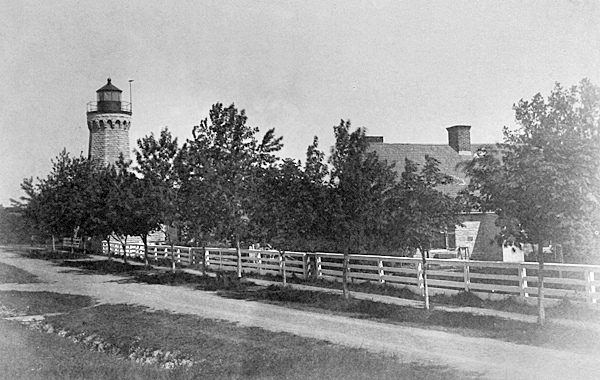
Lighthouse and dwelling in 1885
Photograph courtesy National Archives
In 1855, the keeper’s dwelling and other outbuildings at Fort Niagara were damaged by a tornado, and in 1857 the tower was outfitted with a fourth-order Fresnel lens, and new lantern room which had just 9 panes of glass instead of the 150 used by its antiquated predecessor. The Lighthouse Board requested a new lighthouse for the fort in 1868 as the current wooden tower was so “old and out of repair” that it let “in the snow and rain in stormy weather.” Four chimneys surrounded the octagonal tower, and the previous winter a spark from a chimney caused a dangerous roof fire, which could have easily destroyed the tower’s valuable lens. Moreover, the tower was poorly situated, as it required using “the stairway and passages of the officers’ quarters as a thoroughfare for the supply of the light.”
While waiting for funds for a new lighthouse, the keeper’s dwelling was reshingled and equipped with shutters and rain gutters, and a woodshed, privy, and a barn were built for the keeper.
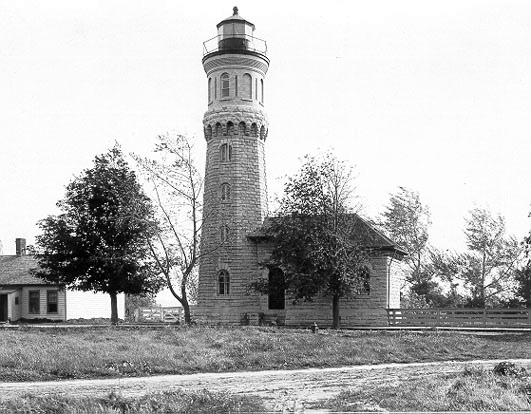
After Congress provided $16,000 on March 3, 1871 for a new lighthouse, plans for a fifty-foot octagonal limestone tower with an attached oil room were drawn up. Work on the structure, which was placed outside the fort’s walls near the stone keeper’s dwelling, commenced in July of 1871, but masonry work had to be suspended on November 30th due to the early arrival of cold weather. Work resumed on April 15th of the following year, and the light from the fourth-order Fresnel lens, transferred from the old tower, was first exhibited on June 10, 1872. The light's focal plane was raised eleven feet, four inches in 1900, when a brick watch room was added between the top of the stone tower and the lantern room.
The military's water main at the fort was tapped in 1889 to provide water for the light station. Also that year, the roof of the station's barn was re-shingled and a wagon shed measuring twelve by sixteen feet was constructed for the convenience of the keeper. In 1894, the Lighthouse Board noted that the keeper's dwelling was “old, in bad condition, and unsuitable” and requested $4,000 to build a new one. Under a contract of June 25, 1896, a six-room, two-story keeper’s dwelling was built 140 feet west of the lighthouse, following plans that had been used for dwellings at Dunkirk and Oswego. At the same time, the “grade of the lot around the dwelling was raised,” and a gravel driveway leading from the lighthouse reservation to a nearby street was made.
In 1899, the Lighthouse Board requested $2,000 to place a light atop a twenty-five-foot tower closer to Lake Ontario to help vessels safely reach the protected anchorage offered by the river. At the time, no port for deep-draft vessels existed along Lake Ontario's south shore between the Genesee River and Port Dalhousie, a distance of nearly ninety miles. This request was repeated annually for six years, but appears to have gone unfulfilled. In 1905, a square iron oil house with a capacity of 540 gallons was erected twenty-five feet south of the lighthouse, and the former oil room was converted into an office and storeroom.
On August 28, 1919, Fort Niagara Lighthouse was electrified allowing for its characteristic to be easily changed from fixed white to four seconds of light followed by a two-second eclipse.
Fort Niagara Lighthouse in 1903
Photograph courtesy U.S. Coast Guard
George F. Ferguson was serving as keeper of the lighthouse in 1929, when he traveled to the Cleveland Clinic for a throat operation. On May 15, Ferguson was walking down a hall after having just undergone a final examination prior to his discharge when a massive explosion knocked him to the floor. The explosion and resulting fire, which killed 123 people, was caused when nitrocellulos x-ray film was ignited by an exposed light bulb. The burning film produced poisonous gases that caused many patients in the clinic to suffocate. When Keeper Ferguson returned to Buffalo, he declined to be interviewed saying, “My nerves are wrecked, I can’t talk about it.” Keeper Ferguson also served as secretary of the Old Fort Niagara Association, and while tearing down some plaster at the fort, he discovered a piece in which the names of four Frenchmen and the years 1741 and 1742 were scratched.
During the prohibition era, Keeper Ferguson was captaining a captured speedboat with 400 gallons of alcohol aboard to the Coast Guard station at Fort Niagara in June 1926, when the vessel caught fire. Ferguson and a deputy sheriff, the only other person aboard, quickly leaped into the vessel’s small dory that was in tow and watched as the speedboat exploded and burned to its waterline. Two Canadians and two Americans were loading the speedboat with alcohol when it was seized by authorities. Keeper Ferguson received a citation from the federal government for his part in the rescue on February 3, 1917 of a young man whose boat was caught in an ice jam at the mouth of Niagara River.
Rather than remove or trim roughly fifty trees that were starting to obscure Fort Niagara Lighthouse, the Coast Guard decommissioned the historic sentinel in 1993 and replaced it with a light on a nearby radio tower. Nancy Price, who had lived in the keeper's dwelling while her husband, Richard, was officer in charge of the Fort Niagara Coast Guard Station from 1968 to 1975, was given the honor of throwing the switch to activate the modern light. Minutes later, her grandson was permitted to pull the plug in the lantern room of the historic lighthouse to darken the Fresnel lens.

The historic lighthouse is currently leased to the Old Fort Niagara Association, which at times has kept a small museum and gift shop in the tower. The Fresnel lens was removed from the tower in 1995 and is on display at the visitors center at Old Fort Niagara. The association holds a number of interesting historical events at the fort each year covering the French and Indian War, Revolutionary War, and the War of 1812. Open year round, Old Fort Niagara boasts both an extensive collection of 18th century military architecture as well as splendid examples of military engineering. In 2013, the windows in the lighthouse were replaced using a $10,000 donation from the East Hill Foundation of Western New York

Thursday, March 6, 2014

Rondout Creek Light Hudson River New York

Another of the two we saw with the Kingston's on the 2009 Hudson River trip.  Beautiful light.  


The Hudson River Maritime Museum interprets the Rondout Lighthouse located at the mouth of the Rondout Creek on the Hudson River, one mile from the museum. The lighthouse is owned by the City of Kingston. The museum has supplied furnishings and provides docents to conduct tours of the lighthouse. This popular attraction is still a working aid to navigation on the Hudson and has an interesting history as the third lighthouse on the Hudson at the entrance to the Rondout Creek. The lighthouse is accessible only by boat and for guided tours.
The first lighthouse at the entrance to the Rondout Creek was a wooden one built in 1837. Little record remains of this 1837 lighthouse. The second lighthouse, made of sturdier bluestone, was built in 1867.
Mrs. Catherine Murdock was keeper of the first and second lighthouses after her husband drowned in 1856, only a year after becoming keeper of the wooden lighthouse. Her son James Murdock, who acted as assistant keeper, became keeper in 1907 upon his mother’s retirement after 50 years of service. In 1913 construction began on a new lighthouse (the current structure) as a new jetty built in the 1890s at the mouth of Rondout Creek meant that the 1867 bluestone lighthouse was set too far back to be an adequate navigation aid. The James Murdock family moved into the new lighthouse in the spring of 1915.
The 1867 bluestone lighthouse was abandoned after 1915 and torn down in the 1950s. Only its circular stone foundation remains today.
Families lived in the present 1915 lighthouse until 1945. The Coast Guard then manned the lighthouse until 1954 when the light was automated and the building closed.
In 1984 the Hudson River Maritime Museum leased the lighthouse and began restoring the building and taking people out to see it. Many groups of school children and adult visitors have toured the lighthouse and enjoyed stories of its history as well as the fine view from the light tower ever since.

Esopus Meadows Light Hudson Bay, New York

Got to this one on a Hudson River Cruise with the Kingston's, way back on 2009 I believe-  Pretty light right out in the Hudson River entrance.  


History

The Esopus Meadows Lighthouse, fondly nicknamed "The Maid of the Meadows", was completed in 1871.  It replaced an earlier structure built in 1839 on land ceded to the United States Government from the state of New York.  The lighthouse was needed on the Hudson River to warn mariners of the mud flats known as the Esopus Meadows located off the western shore of the river.

The lighthouse was built on a new foundation, located to the south of the former location, traces of which are still visible on the adjoining small island.  Two hundred and fifty piles, each 40 feet long, were driven into the river bottom.  They were cut off three feet below the mean water mark, capped with 12 inch square timers and topped with a deck of three-inch pine.  Granite blocks were stacked 16 feet high producing a pier with a diameter 49 feet at the base and 46 feet at the top.  On top of this pier was built a wooden keeper's dwelling with a mansard roof and clapboard exterior.  Inside the house is a kitchen, sitting room and equipment room on the first floor and three bedrooms and a bath on the second.

The light tower extends above the living quarters with an octagonal deck housing the light. Situated 53 feet above the mean water line, the lantern room previously contained an optic fifth-order Fresnel lens providing a 270 degree arc of light that was visible for 12 nautical miles.

The lighthouse was tended by resident keeper until 1965 when it was converted to an automatic solar powered system. Although only accessible by boat, without the care of on-site keepers, the lighthouse fell into the ruinous hands of vandals and Mother Nature.

In 1979, the Esopus Meadows Lighthouse was listed on the National Register of Historic Places. The road to restoration didn’t really begin until 1990 when the Save Esopus Lighthouse Commission was formed. The concerned volunteers, under the direction of Arline Fitzpatrick, leased the site from the Coast Guard and began extensive restoration efforts. SELC raised funds from various sources to cover emergency repairs, extensive carpentry, painting and shingling of the mansard roof.

By 1997, a reorganization of SELC, as well as new volunteers from the  Aids to Navigation Coast Guard Station in Saugerties, continued to bring the lighthouse back to life.

The fall of 2000 brought an impressive milestone in restoration efforts – stabilization and leveling of the house was completed.

July 2001 brought another milestone for the lighthouse. The restoration was reorganized as a museum under the New York State Regents providing a provisional charter as the Esopus Meadows Lighthouse which allows the pursuit of additional funding and ownership of the house.

In September 2002, the lighthouse stewardship was formally granted by the General Services Administration to the newly-chartered Esopus Meadows Lighthouse.

Perhaps the most rewarding achievement to date happened on May 31, 2003. After 38 years of darkness, a new light was installed in the tower, thereby deeming the house “a working navigational aid.”

The following items are a small list of achievements since the restoration project began:
  • Replacement of destroyed and missing balusters
  • Installation of missing shutters
  • Leveling and stabilization of the house
  • New wiring throughout the structure
  • Installation of a generator and battery bank
  • Repainting of the exterior (a never ending project)
  • Installation of a solar panel
  • Wiring of an alarm system
  • Erection of a lightening arrestor
  • New hand-crafted double doors
  • Replastered the wallboard throughout the structure
  • Plastering of all interior rooms