Showing posts with label Rhode Island. Show all posts

Thursday, March 6, 2014

Rose Island Light Newport, Rhode Island

Another on the 10 light Newport Harbor light tour 


Through the years, Rose Island has been used by the military due to its strategic location at the entrance to Newport Harbor. During the Revolutionary War, the island was used by both British and colonial troops at different times to defend Newport. From 1798 to 1800, a military outpost named Fort Hamilton was under construction on the island, but it was never finished. In 1889, part of the island served as a rifle range, and during World War I and II it was used for storage by the U.S. Navy’s torpedo manufacturing plant in nearby Newport. Keepers stationed at Rose Island could definitely not expect peace and quiet all the time.
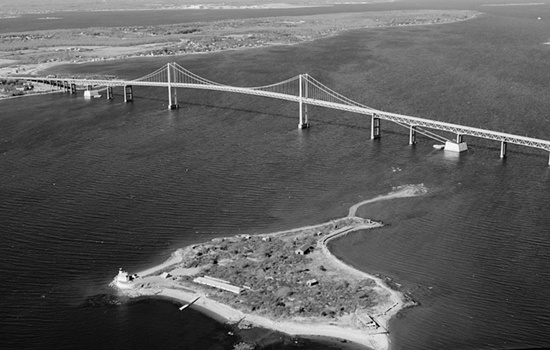
The wood-framed lighthouse that stands on the island today was built in 1869 using $7,500 allocated by Congress the previous year. Activated on January 20, 1870, the Rose Island Lighthouse stands atop Fort Hamilton’s South Battery on the southwestern point of the island and replaced a private light maintained by the Bristol Steam Boat Company. The thirty-five-foot tower is attached to the western end of the keeper’s dwelling, which is two stories tall and topped with a mansard roof. The optic in the lantern room was originally a sixth-order Fresnel lens that displayed a fixed red light to guide mariners traveling along the East Passage of Narragansett Bay and those entering Newport Harbor. A brick oil house was added to the station in 1912 along with a brick fog signal building that was placed on a rock just west of and below the lighthouse.
Aerial view of Rose Island Lighthouse
Photograph courtesy Library of Congress
Because of its proximity to Newport, Rose Island was not as isolated as many lighthouse stations. However, keepers on duty there still had to deal with extreme weather at times. On February 2, 1876 the wind reached near-hurricane force and shook the tower violently. Two weeks later, another storm dragged the station’s boat and its 600-pound mooring onto the beach, damaging the boat. The wind moved the tower “1 ½ inches each way so that it broke the plaster inside of the house and the glass chimney in the lantern.”
On April 4 of the same year, yet another storm took the tower’s chimney down, and the roof leaked so badly that it was almost “as wet inside as out.” In November, a storm flooded the lighthouse, ruining the entire winter supply of vegetables stored there. The following month was no better, according to the lighthouse log: “Stormiest December on record, much damage to property and according to report, much loss of life at sea.”
In 1894, Captain Elijah Davis, who was nicknamed the Fog Eater for his skill at navigating in zero visibility, met his match when he ran his steamer Plymouth aground on the south shore of Rose Island. The 700 passengers on board were offloaded with no injuries, but the ship remained stranded on the island for several weeks.
Lighthouse keepers were not well paid, and they sometimes had to be creative to feed their families. At Rose Island, the keepers grew crops and kept farm animals, which sometimes wandered from the lighthouse grounds into the military compound, much to the officers’ annoyance. Two keepers at Rose Island, Charles Curtis (1887-1918) and Jesse Orton (1921-1936) both kept cows at the light station to supply milk. Curtis kept his cow in a long building behind the lighthouse that was also used for storing explosives.
Paul Stedman, one of Jesse Orton’s grandsons, tells the story of how his grandfather went ashore, bought a cow, and then brought it to the island aboard the Jamestown ferry. The ferry captain tried to maneuver his vessel close enough to the island to let down a gangplank to walk the cow ashore but was unable to find a suitable spot in the shallows. The ferry crew was thus forced to lower the cow into the water and have the bovine paddle her way to shore. With everyone on the ferry shouting their encouragement, the cow barely made it to the island, where she collapsed to the ground. Twenty-four hours passed before she had the strength to stand up and graze.
The Rose Island Lighthouse narrowly avoided destruction on August 7, 1958 when two tankers collided in heavy fog near Fort Adams and burst into flames. One of the ships, the Graham, floated into Newport Harbor with the tide, ablaze and with her engines dead, and passed within 200 yards of the Rose Island Light. The walls of the lighthouse became so hot that the keepers were forced to flee the station. Finally, the tide and wind turned and took the ship away from the lighthouse. Eighteen men from the two ships were killed in the incident.
When the Newport Bridge was opened in 1969, both the Gould Island Lighthouse north of the bridge and the Rose Island Lighthouse became obsolete. Rose Island was deactivated in 1971. In 1976, the lighthouse and grounds were given to the University of Rhode Island to use for marine research, but the school was unable to maintain the property, and the decrepit, badly vandalized lighthouse was returned to the federal government. When the lighthouse was declared surplus property in 1984, the city of Newport took it over.

A local group, the Rose Island Lighthouse Foundation, was formed, and with the help of public and private funding, the ambitious organization completely restored the lighthouse. Much of the credit for the group's success is due to its first director, Charlotte Johnson, who devoted many years to the project. The exterior of the lighthouse was completely refurbished in 1990, and the interior received new wiring, plumbing, and plaster walls, as well as an energy-efficient in-floor radiant heating system. A septic field, a water cistern, and a landing dock were also installed. Altogether the restoration cost $250,000. In 1992, the lighthouse was opened to the public. The following year, the lighthouse once again became an active aid to navigation, showing a white light flashing every six seconds. In 1999, the Rose Island Lighthouse Foundation acquired the rest of the island, which is off-limits, save its beaches during a portion of the year, due to safety concerns.

Poplar Point Light Newport Harbor Rhode Island

Another on the 10 light tour from Newport Harbor 


Poplar Point Lighthouse is an excellent example of an “integral” lighthouse – that is one in which the light tower is incorporated into the keeper’s living quarters. Integral lighthouses were appealing to their frugal overseer as they cost little more to build than a regular house. The earliest integral lighthouse in the United States was built in Plymouth, Massachusetts in 1769.
Quite a few integral lighthouses were built during the early 1800s, but when the Lighthouse Board took over lighthouse administration in the 1850s, it found many of these lights to be inadequate for their purpose, in poor condition, or both. Most of these integral lighthouses were torn down and replaced, usually with taller towers. Only five integral lighthouses remain from the time of Stephen Pleasonton, Fifth Auditor of the Treasury and supervisor of U.S. lighthouses from 1820 to 1852. Besides Poplar Point, the surviving integral lighthouses are Point Lookout Lighthouse and Fishing Battery Lighthouse, both in Maryland, Selkirk Lighthouse on the eastern shore of Lake Ontario in New York state, and East Point Lighthouse in New Jersey. All of these have gone through long periods of neglect except for the Poplar Point Lighthouse, which has been continuously occupied and well preserved throughout its history.
In 1831, Congress approved $3,000 for a navigational beacon at Wickford Harbor, and Poplar Point, at the southern entrance to the harbor, was selected as the site for the lighthouse. Land was purchased from Thomas Albro for $300, Charles Allen was hired to build the lighthouse for $1,889, and Winslow Lewis was contracted to supply the lamps and reflectors for $375.
The octagonal tower was built of wood and attached to the eastern gable of a one-story, rubblestone keeper’s dwelling. Access to the tower, whose interior was initially left unfinished with its studs exposed, was through a small, windowless bedroom, which during the winter, was unlivable as its unlined walls freely admitted cold and snow.
Poplar Point’s first keeper was Samuel Thomas, Jr., who received his appointment in November of 1831 at an annual salary of $350. Lieutenant George M. Bache included the following details on Poplar Point Lighthouse in an 1838 report.
The light is shown from a wooden tower placed over the keeper's dwelling and is elevated 48 feet above high-water mark. The lighting apparatus consists of eight lamps with concave reflectors, so disposed around two circular rims or hoops as to throw their light over the portion of the bay and harbor included between the SE. by E. and NW. by W. points.
The lamps are in good order. The reflectors average in weight nearly three pounds; their diameters are 14 1/2 inches. A portion of the silver has been rubbed from their concave surface at the upper hole, through which the glass tube should pass; they are otherwise in good condition.
The lighting apparatus was replaced in 1855 by a sixth-order steamer lens, still showing a fixed white light.
It seems the Poplar Point Lighthouse did little to help vessels coming through Narragansett Bay’s West Passage, as it was located within a shallow bay two miles from the middle of the channel. The lighthouse did, however, serve as an entrance light for Wickford Harbor, but few ships would attempt to enter Wickford Harbor after dark, instead waiting for daylight at the well-protected anchorage between Dutch and Conanicut Islands.
In 1870, the inside of the tower was finally finished, a dormer window was installed in the attached bedroom, and a partition was put in place to separate the bedroom from the tower. The inside walls of the tower were also finished, and a new lantern with an iron deck was installed.
Poplar Point Lighthouse had a short life. In 1880, Congress appropriated $45,000 for lighthouse on Old Gay Rock at the mouth of Wickford Harbor, just offshore from Poplar Point. When the Wickford Harbor Lighthouse was activated on November 1, 1882, the Poplar Point Lighthouse was discontinued. Keeper Henry F. Sherman, who had been serving at Poplar Point since 1874 was transferred to the Wickford Harbor Lighthouse, where his annual salary remained $480. The Wickford Harbor Lighthouse was torn down in 1930 and replaced by a metal tower. A modern beacon can still be seen on the lighthouse's original pier today.

After Poplar Point was closed, the land and buildings were sold at auction to an Albert R. Sherman of Pawtuxet, RI for $3,944.67. The property has been resold a number of times over the years, mostly being used as a summer home and now a year-round residence. Both the tower and the dwelling are well preserved, although various owners have added to it over the years and altered its original appearance. The Poplar Point Lighthouse is listed in the National Register of Historic Places.

Plum Beach Light, Newport Harbor Rhode Island

Yet another of the 10 light boat tour of Newport RI on the 2013 trip 


Mariners who used the West Passage of Narragansett Bay in the late 1800s plead for a navigational aid near Plum Beach Shoal for many years. Sometimes in heavy fog, captains trying to avoid Dutch Island went too far west and ended up running aground on the shoal. In 1895, Congress finally approved $60,000 for building a lighthouse and fog signal at Plum Beach. Just after construction of the cast-iron tower began during the summer of 1896, crews discovered that the bedrock was much deeper than they had thought, and funds ran out before the foundation could be securely anchored. When work stopped, the foundation was barely above high mean water and was covered with timber. A temporary warning light and fog bell were mounted atop the foundation.
Plum Beach Lighthouse
Photograph courtesy U.S. Coast Guard
When Congress allocated additional funds in 1898 work resumed, but poor weather caused more delays. During a blizzard, the construction ship dragged anchor and headed down the West Passage of the bay. Just when it looked as if the schooner and crew would either smash on the rocks or be carried out to open sea, the anchor caught on a cable near Beavertail. In a December 3, 1898 letter to the Lighthouse Board asking for a temporary halt to construction, the contractor wrote, “Plum beach, Narragansett Bay is the stormiest place we ever worked. It is either raining or blowing half the time.” Work ceased shortly thereafter and resumed in the spring. The lighthouse was finally completed in May of 1899.
The cast-iron foundation of the Plum Beach Light is one of thirteen light stations that were built using a unique pneumatic construction technique. First, a multi-sectioned caisson was assembled and put onto a barge. Before being transported, a central access pipe was inserted into the caisson. This pipe contained air supply and pressure tubes, a ladder, and a system to convey sand and muck up to the surface.
After being barged to the construction site, the caisson was turned upright and sunk into the soft seabed. Once the caisson had settled, water was pumped out from the empty chamber at the bottom. At the same time, sections from the high mean watermark downward were filled with concrete. As the debris was cleared out, the caisson settled about thirty feet into the bay’s floor.
The beacon was a kerosene-powered fourth-order Fresnel lens showing a flashing white light. The lens floated on a mercury bed and was rotated by a clockwork mechanism activated by weights dropping through a central tube.
The winter of 1918 was a difficult one at Plum Beach Lighthouse. The entire bay froze over allowing automobiles to drive across the ice. The shifting of the thick sheets of ice caused a one-inch crack that circled the entire lighthouse to develop two feet above the low tide level. Other vertical cracks extended below the water line. The construction bids received for the repairs were considered too high, and nothing was done for several years. Finally in 1922 the cracks were fixed, and an additional 9,000 tons or riprap were placed around the foundation for extra protection. The repairs held until 1938, when the Great New England Hurricane opened the old cracks, created new ones, and caused quite a bit of damage to the tower. Keepers Edwin Babcock and John Ganze were unable to get away from the station before the storm and had to ride the hurricane out in the tower. Waves as high as thirty-five feet tore open doors and flooded the building. The two men tied themselves to the center pipe containing the weights that turned the beacon. Lighthouse and keepers made it through the storm in one piece, unlike the Whale Rock Light five miles away, which was destroyed.
When the first Jamestown Bridge opened in 1940, the Plum Beach Light was made obsolete. The beacon was permanently turned off in January of 1941 and put up for auction by the Coast Guard, with the proviso that the winner had to dismantle and move the lighthouse. There were no bids, and the station was abandoned shortly thereafter. A long period of neglect followed, during which windows and doors disappeared, the cast-iron rusted, and bird droppings piled up on all the decks.
The Coast Guard and the state of Rhode Island bickered over the lighthouse for years, with neither party wanting to assume responsibility for the structure. In 1984, James Osborn, who was paid to paint the lighthouse in 1973, filed a $500,000 lawsuit against the state to compensate for an eye disease he contracted from all the guano in the tower. The lawsuit went back and forth between Rhode Island’s Superior and Supreme Courts for years. In June of 1998, the courts determined the state was the owner of the lighthouse, and three months later the state paid Osborn $42,000.
In 1988 a private company tried to buy the lighthouse and move it to a condominium complex in Quincy, Massachusetts, where it would be turned into a lighthouse history museum. When this plan became public, the Friends of Plum Beach Lighthouse was formed to retain the tower and preserve and restore it in place. Neither group, however, was able to move ahead with their plans as the question of ownership was still being debated in the courts.
With the ownership issue resolved, the state gave the title to the Friends of Plum Beach Lighthouse in 1999. The nonprofit obtained $500,000 that same year under the Transportation Act for the 21st Century, and Newport Collaborative Architects visited the site in 2000 to estimate the cost of completely restoring the tower.
In 2003, restoration of the exterior of the lighthouse was begun by Abcore Restoration Company. The first step was the removal of over 50 tons of guano left by feathered visitors over the years. The interior was fully cleaned and the outside painted and repaired. In December of 2003, the station was relighted for the first time in 62 years, using a solar-powered beacon flashing a white light every five seconds. 

Lime Rock (Ida Lewis) Light, Newport Harbor RI

Another of the 10 lights on the Newport Harbor Light Trip 


Ida Lewis Lighthouse, which was formerly the Lime Rock Lighthouse, is in the Newport harbor in Rhode Island. It is name after Ida Lewis, who was the lighthouse keeper from 1879 until her death in 1911. She was celebrated for many acts of bravery in saving lives.
In 1853, Congress authorized the construction of a lighthouse on Lime Rock in Newport Harbor. Lime Rock is a limestone ledge about 220 yards (200 m) from the shore. The original lighthouse was a short stone tower with a 6th order Fresnel lens and an oil-burning lantern. The light was commissioned in 1854. In the beginning, the lighthouse keeper rowed from the shore daily to tend the light. In case of foul weather, the lighthouse keeper could stay in a small wooden shanty.
The first lighthouse keeper was James Stockbridge Lewis, who had assisted in its construction. After six months, Hosea Lewis, who was the father of James Lewis and a retired pilot, was appointed keeper. In 1857, a two-story house was built for the lighthouse keeper. Lewis and his family moved to the small island in 1857.
Lime Rock Island in 1869
A few months after he moved to the island, he suffered a stroke. His wife, Ida Zordia Lewis and her children tended the light. Their eldest daughter, who was also named Ida Lewis, did much of the work. After her mother died, she was officially appointed lighthouse keeper from 1879 to 1911. The island and the lighthouse were named for Ida Lewis in 1924.
The last lighthouse keeper was Evard Jansen. He remained until the light was automated in 1927. The original light was replaced with an automated, acetylene light on a skeleton tower. It was deactivated in 1963.
The original Fresnel lens is on display at the Museum of Newport History. The lighthouse is maintained as the clubhouse of the Ida Lewis Yacht Club. They have a light as a private aid during part of the year.
The Ida Lewis Lighthouse is on the National Register of Historic Places, No. 87001700.

Dutch Island Light, Newport Harbor Rhode Island

Another one of the Rhode Island Bay Cruise lights.  


Dutch Island, between Jamestown to the east and Saunderstown (a village of North Kingstown) to the west, was known to the local Indians as Quetenis.

Picture
The 81-acre island got its present name because the West India Company established a trading post there in the 1630s. They traded Dutch goods in exchange for furs, meat and fish from the Indians.

The federal government acquired six acres at the southern tip of the island in 1825, and on January 1, 1827, a light station was established to mark the west passage of Narragansett Bay and to aid vessels entering Dutch Island Harbor. The first 30-foot tower was built of stones found on the island.

The first keeper was Newport native William Dennis. Dennis had gone to sea at a young age and was in command of a merchant vessel based in London, but on receiving word of the outbreak of the American Revolution he returned home to fight for the colonists.

Picture
Circa 1859 (U.S. Coast Guard)
During the course of the war he commanded six different privateering vessels and was twice taken prisoner. He later served as sheriff of Newport County for a dozen years beginning in 1801.

Appointing war veterans as keepers was a common practice, but what made this case unusual was the fact that William Dennis was nearly 80 years old at the time he took the job in 1827.

He went on to become one of the oldest lighthouse keepers in New England history, serving to the age of 93. His son, Robert, later served as keeper.

The four-room keeper's dwelling and the lighthouse were described around the mid-nineteenth century as the "worst constructed of any in the state," and the lantern was described as "wretched." An 1850 inspection praised Keeper Robert Dennis, saying he was "a good honest man, and I think he shows a good light, although a moderate consumer of oil."

A second 42-foot brick tower and keeper's house were constructed for $4,000 in 1857, with a fourth-order Fresnel lens showing a fixed white light.

George Fife became keeper in 1875. When a fog bell with striking machinery was added in 1878, with the bell protruding from a window near the top of the tower, Keeper Fife's wife was appointed as an assistant keeper to help with the extra duties. She retained the position until she and her husband left Dutch Island in 1883.

The early keepers had a well, but the brackish water was not suitable for drinking. A proper cistern for the collection of rainwater was added in the basement of the keeper's house in 1878.

Other than the lighthouse station and the pasturing of sheep, the island saw little activity in the nineteenth century until a Civil War encampment was established. Gun batteries were added after the Civil War, and the batteries were expanded around the turn of the century. By the late 1800s the fortifications were named Fort Greble, after Lieutenant John T. Greble, one of the first officers killed in the Civil War.

The facility housed as many as 495 personnel during World War I, but other nearby defense installations rendered Fort Greble expendable. The island's military use ended in 1947, but remnants of the buildings and gun emplacements remain.

Despite the presence of the light and fog bell, vessels frequently went aground on and near the island.

Picture
Keeper John Paul
On January 21, 1903, when Albert Henry Porter was keeper, the steamer Seaboard of the Joy Line "nearly knocked the little lighthouse . . . off the rocks," according to a newspaper account. The steamer had been making its way north in a thick fog, and was apparently going a bit too fast when the lighthouse suddenly appeared. Fortunately for the station and its residents, the jagged rocks at the southern end of the island halted the ship's progress about 30 feet from the tower. The steamer was badly damaged, but there were no casualties.

One of the more prominent wrecks at Dutch Island was the Rosalie, which ran up on the island in the early 1900s with a cargo consisting of barrels of white beans. It was reported that local boys found plenty of ammunition for their bean shooters that year.

The lighthouse almost met a premature demise in 1923. Someone was burning trash in the back yard of the keeper's house when the wind picked up and almost set the tower ablaze. Men stationed at the fort helped put out the fire, and only a storehouse was lost.

John Paul, previously at Fall River's Borden Flats Light, was keeper at Dutch Island from 1929 to 1931. Keeper Paul's son Louis later remembered that his father maintained a garden and kept ducks at the station. Keeper Paul found the fishing around the island first-rate; he would catch a "bushel of blackfish" before breakfast, according to his son. Keeper Paul would ride ashore occasionally on a ferry to pick up supplies in Saunderstown or Jamestown. He would buy huge quantites of food, sometimes a whole side of beef that he would salt for extended use at the light station.

Ernest Homer Stacey, originally from Rouses Point, New York, arrived as keeper in 1941. Although Stacey loved living at Dutch Island, his wife, Dot, was a "city girl" and wasn't so pleased.

Picture
Dutch Island held countless annoyances for Dot Stacey. Before she'd use the water from the cistern in the basement for washing their laundry, she insisted on boiling it because she claimed it had an odd smell. Dot once hung the laundry outside to dry, only to have a sudden strong wind blow it into the bay. She wasn't at all amused when Keeper Stacey fished out her bloomers three days later.

Left: Ernest Stacey was the last keeper. Courtesy of his daughter, Angel (Crissie Stacey) Derouchie.

The light's characteristic was changed to occulting red in 1924. The light was automated in 1947, and the last keeper, Ernest Stacey, was removed.

In 1958, after the military use of the island had ended, the entire island except for the light station was deeded to the state of Rhode Island. The deed stated that the island was to be used "for the conservation of wildlife."

A report in April of 1960 stated that the keeper's house had "deteriorated greatly in the past 10 years; that all windows and doors have been broken or removed; all paint is peeling; several areas of plaster have fallen, and the roof whos signs of leaking." The report also indicated that the wooden boathouse had been moved about 100 feet in a recent storm. The dwelling and boathouse were demolished by the Coast Guard a short time later.

All that remains today is the lighthouse, a 1938 concrete engine house, and the remains of a well.

Picture
In 1962, the light station property, except for the tower, was transferred to the state of Rhode Island. The island and lighthouse are now owned by the Rhode Island Department of Environmental Management (RIDEM). The Coast Guard proposed discontinuing the light in 1972, saying it had outlived its usefulness. They pointed out that in January of that year the light had been out for several days before anyone reported the problem to authorities. There was tremendous opposition to discontinuing the light.

 Right: Ernest Stacey and son Robert at the lighthouse. Courtesy of Angel (Crissie Stacey) Derouchie.

Several petitions and 40 to 50 letters opposing the move were received by the Aids to Navigation office in Boston, and the Rhode Island Natural Resources Department said the light was needed to guide small craft to Dutch Island Harbor. As a result of this pressure, the Coast Guard not only retained the light, but actually increased its intensity.

Due to rampant vandalism, the Coast Guard again proposed discontinuing the light in 1977. In that year alone, vandals smashed the door and stole equipment. Someone even poured liquid steel into a lock. It was just too expensive for the Coast Guard to keep up with the repairs, and Dutch Island Light was officially discontinued in 1979, replaced by offshore buoys.

Shirley Sheldon of Saunderstown and other nearby residents initiated a preservation effort. The effort was abandoned when the group realized the deterioration of the lighthouse was worse than they had feared.

Picture
The lighthouse in 2000
Then, a group from the American Lighthouse Foundation (ALF) visited the lighthouse in May 2000, accompanied by Chris Powell of the Rhode Island Department of Environmental Management Division of Fish and Wildlife. The Dutch Island Lighthouse Society (DILS) was subsequently founded to work for the restoration of the lighthouse. The lighthouse was found to be in poor condition but restorable. DILS was later recommended for $120,000 in Transportation Enhancement funding under the Transportation Equity Act for the 21st Century (TEA-21).

After a formal bid process, Abcore Restoration Co., Inc., was awarded the contract for the restoration. Abcore previously restored the Plum Beach and Pomham Rocks lighthouses in Rhode Island. The federal/state grant covered most of the base cost of restoration ($160,000).

The work was completed in November 2007. At a little after 7:00 p.m. on November 17, the lighthouse was relighted as an aid to navigation. Restoration has included interior and exterior repairs to the brick lighthouse tower, guano removal, replacement of floors and metalwork, and the repair of interior stairs. Graffiti and rust have been covered over, and the tower now has a white stucco finish.


The lighthouse can be viewed from the Fort Getty Recreation Area. There is a fee to enter the area, but if you explain that you just want to photograph the lighthouse you might be allowed in for a short visit.


Conanicut Island Lighthouse Newport Rhode Island

Another of the 10 light cruise from Newport RI.  


Conanicut Island, which divides Narragansett Bay into its East and West passages, is nine miles long and a mile wide. The island is named for Conanicus, Narragansett sachem and friend of Roger Williams. Artifacts have been found indicating Native Americans used the island 5,000 years ago and probably earlier.

Picture
With new steam ferry services available in the early 1870s, the island gained in popularity as a summer resort. A steam ferry between Jamestown and Newport began running in 1873, replacing a small sailing vessel used mostly by farmers. Steamship travel also ran between Wickford—the terminus of a railroad line from New York City—and Newport. Bridges from Conanicut Island to Saunderstown and Newport weren’t completed until 1940 and 1969, respectively.

For some years, the Newport and Wickford Railroad privately maintained a simple light and foghorn at the northern tip of the island. The steamship interests appear to have played a major role in the Lighthouse Board’s decision to build a lighthouse at Conanicut Island’s northern tip, primarily as a guide for vessels heading south on their way to Newport or the Atlantic Ocean.

Congress appropriated $18,000 in July 1884. The contractor in charge of construction was Linas Seeley, and the lighthouse was finished by early spring of 1886 and first lighted on April 1. A fixed red light was exhibited from a fifth-order Fresnel lens with a focal plane 47 feet above the bay. The lighthouse took the form of a handsome two-story, wood-frame Gothic Revival house with six rooms, with a square tower attached to the northeast corner. The building was very similar to the lighthouse built four years earlier in Wickford Harbor.

An air siren replaced the original fog bell in 1900. The continuous blast produced in times of fog by the new equipment most likely wasn’t appreciated by the neighbors. A brick oil house was built in 1901, and a new brick building was added in 1907 to house the equipment for a new steam-driven fog signal. The barn, oil house, and fog signal building all survive today.

The first keeper was Rhode Island native Horace Arnold, veteran of a dozen years at Conimicut Light to the north. A newspaper article about Arnold on the occasion of his death said he was born on Prudence Island and came from a family of lightkeepers. He served in the Civil War as a member of Company G, Fourth Rhode Island Infantry. After surviving three years in the war, Arnold nearly lost his life in a shipwreck on the Potomac River on his way home.

A 1914 article described Arnold's life as "routine but pleasant" at Conanicut Light:

Picture

The excitements of former days had passed and the captain found in his later years a haven where he could rest as well as do the work of his position, and where he did much to add to the pleasure of his home life by cultivating the garden about the house and making it agreeable for his many friends who frequently called upon him.

Arnold once made a risky walk out onto the ice from the lighthouse to assist the passengers of a stranded vessel.

Picture
The boat's skipper presented the keeper with a captain's chair for his considerable efforts, and the chair remained a treasured possession of the Arnold family for many years. Arnold remained at the light station until his death from pneumonia at the age of 74 in February 1914.

The lighthouse's second and final keeper was Elmer V. Newton. Newton stayed in charge until 1932, when it was decided that decreased shipping traffic meant money could be saved by transferring the navigational light to an unattended 50-foot steel skeleton tower about 55 feet east of the lighthouse.

The lighthouse, with the lantern room removed, was sold at auction for $2,785. The automatic light remained in use until April 21, 1982. The skeleton tower was quickly dismantled and sold for scrap.

The lighthouse was white with dark trim during its active years. Today it's painted red and white, and still retains its gingerbread trim. Despite the addition of a small sunroom, the building remains well cared for and largely unchanged.

Scenes in the 2011 movie Moonrise Kingdom were shot at the lighthouse and other locations around Jamestown.

In its location on North Bay View Drive, it's difficult to get a good view of the entire lighthouse from the road due to the surrounding trees. Views are available from some sightseeing cruises in the area.

Picture
Helene and Ras Lischio, owners and residents of the Conanicut Lighthouse, during a visit in May 2012.
Picture
A view from the top.
Picture
Ras Lischio at the top of the old lighthouse tower.


Castle Island Light- Newport Rhode Island

This was part of a 10 light boat tour from Newport Area-  


Castle Hill, at the westernmost point of Newport, was the site of a watchtower built in 1740. It was an obvious site for a light and fog signal to aid mariners heading to Newport Harbor and up Narragansett Bay's East Passage toward Providence.

Picture
In 1869, the Lighthouse Board's annual report made the case for such an aid:

Applications have been made at various times in the past, and renewed this year, for a light-house and fog signal on Castle Hill, to guide vessels, especially in thick and foggy weather, into Newport Harbor and Narragansett Bay.

After a careful examination of the locality, and a full consideration of the whole subject, it is recommended that an efficient fog signal be authorized for this point.

Congress appropriated $10,000 for a fog signal at Castle Hill on March 3, 1875. 

Picture
Alexander Agassiz (1835-1910)
Just a short time before the appropriation, a large summer home was built on the property that was coveted by the Lighthouse Board. The owner was biologist and industrialist Alexander Emanuel Agassiz.

Agassiz had made a large fortune as the president of a mining company. Agassiz established a marine laboratory on the site that operated until his death in 1910.

Agassiz refused to sell, and the $10,000 was allowed to "lapse back to the Treasury." A buoy with an automatic whistle was proposed for the area near Castle Hill, but the idea was discarded because of the sheltered nature of the location. The proposal for a fog signal at Castle Hill was revived in 1886, and another $10,000 was appropriated. This time the plans were to include a lighthouse, provided a suitable site could be obtained "without expense to the Government."

Agassiz relented and gave a suitable portion of his property to the government for $1 on June 10, 1887. 

Picture
Early plans for Castle Hill Light by H. H. Richardson
Contractor William T. Wilbur of Newport was hired to build the station. Water access to the rocky site was problematic, and Wilbur was guaranteed he would be allowed right-of-way across Agassiz's property. Agassiz objected. He wrote on May 22, 1888, to the Third Light House District, "What with one thing and another I stand an excellent show of having my place ruined and nobody to foot the bill."

In November 1888, the engineer of the Third Light House District was directed to confer with Agassiz. In the case that Agassiz continued to refuse to agree to more acceptable terms, the government would take the necessary steps "to obtain title by proceedings in condemnation." Agassiz apparently "saw the light," or realized that he would, in the long run, lose his battle with the government. On May 20, 1889, he deeded 1.98 acres to the United States "without condition and without expense to the Government." Meanwhile, an additional $5,000 was appropriated, as it was realized that the 1886 funding was insufficient to build the station.

Architect H. H. Richardson made an early drawing for the proposed station. Richardson was the designer of such acclaimed buildings as Boston's Trinity Church and the Buffalo State Hospital in New York. His favored style became so popular that it was dubbed "Richardson Romanesque" after its originator. The style is characterized by rough-hewn masonry and rich details and textures, and those elements are evident in the drawing for the lighthouse.

The 34-foot tall granite lighthouse was first lighted in May 1890, with a fifth order Fresnel lens exhibiting a flashing red light visible for 10 nautical miles.

The keeper's house was a short walk away at Castle Hill Cove. The first keeper was Frank Ward Parmele. 

Picture
Frank W. Parmele. Courtesy of Cinda Parmelee.
Parmele was from Guilford, Connecticut, and had served as a keeper on Faulkner's Island near Guilford, as well as at Saybrook Breakwater Light. He was a descendant of John Parmele, one of the original founders of Guilford, who arrived there from England in 1639. Parmele and his wife, Lillian (Norton), had three children.

The station had a fog bell, but it had been in operation for only 17 months when it was discontinued at Agassiz's request.

Five years later a larger, louder bell was installed and Agassiz again complained; this time a screen was set up to soften the sound.

The tower was originally all gray; the upper half was painted white in 1899.

During the hurricane of September 21, 1938, which did tremendous damage in Newport, the waters from Castle Hill Cove and the beach nearby met, turning the point into an island.

Agassiz's daughter-in-law was in the cottage at the time, and was so traumatized by the storm that she vowed to never spend time there again.

Picture

Soon after the hurricane, operation of the lighthouse was taken over by Coast Guard personnel from the new Station Castle Hill, a short distance to the northeast. For some years, the keeper's house served as the residence of the officer in charge of the station.

The Agassiz cottage was sold to J. T. O'Connell, who had established a chandlery on Newport's Long Wharf. O'Connell eventually transformed the property into an inn and added several smaller guesthouses. O'Connell died in 1974, but the property is still maintained as the Castle Hill Inn and Resort.

Friday, February 28, 2014

Beavertail Lighthouse, Jamestown (Newport) Rhode Island

Got to this light as part of the Newport Lighthouse Boat Tour, one of 10 on the tour. 


The shot I took on the tour
Beavertail Lighthouse, built in 1749, was and still is the premier lighthouse in Rhode Island, USA, especially for entrance into Narragansett Bay. The 45-foot (14 m) lighthouse lies on the southernmost point of Conanicut Island in the town of Jamestown, Rhode Island in Beavertail State Park. The light has been reconstructed multiple times since its erection, most recently after the Hurricane of 1938. Restoration projects have come and gone since. The light provides navigation for boats and ships entering Narragansett Bay in the East Passage between Conanicut Island and Newport, Rhode Island on Aquidneck Island. Other lighthouses, such as Castle Hill Lighthouse, Point Judith Light, and Rose Island Light are visible from Beavertail Lighthouse.
Its white light rotates counterclockwise and makes a full rotation in about six or seven seconds. The light is on 24 hours per day, unlike many lighthouses that are near it. It has a loud foghorn that blasts about every 30 seconds during the fog.
History
Prior to the establishment of a lighthouse at Beavertail, local Native Americans would keep pitch fires burning, to warn sailors away from the rocky coastline. In 1749, a wooden tower was built, and the light (which was then known as "Newport Light") became the third lighthouse established in the colonies, preceded only by Boston Light in Boston Harbor, and Brant Point Light, Nantucket. A fire was lit at the top of the tower, as was common for the time. Four years later it burned down and was replaced by a stone tower.
In 1779, as British sailors retreating from Newport near the end of the American Revolutionary War, they left a trail of destruction behind them. This included burning the lighthouse and removing the optics, which left the light dark for the rest of the war.
In 1856, the tower was again replaced with what is now the current tower, made of granite which is 10 ft (3.0 m) square, and 64 feet (20 m) from ground to beacon. A 3rd order Fresnel lens was placed and over the next forty years it was the site of numerous fog-signal tests, under the supervision of the United State Lighthouse board. In 1898 quarters for an assistant keeper were added to the keeper's house, the assistant helped, among other things, with fog-signaling.
During the 1938 hurricane, the whistle house was destroyed, revealing the original base for the 1749 structure, which sits 100 feet (30 m) from the current tower. A few miles southwest of Beavertail point, Whale Rock can be seen, resembling a submarine attempting to surface. Whale Rock Lighthouse, and its keeper, Walter Eberle, were swept into the waters of Narragansett bay during the hurricane of 1938; Eberle's body was never recovered.
In 1939, the US Coast Guard took command of all lighthouses and navigational aids, and in 1989 Beavertail light was automated, as part of a program by the Coast Guard, which ended the job the keeper at all stations except for Boston Light, which to this day, remains the only manned lighthouse in America.
In 1989, following a joint effort by the US Coast Guard, Rhode Island Parks Management, the Rhode Island Department of Environmental Management, and the town of Jamestown, the building was restored and reopened to the public. In 1993, Beavertail Lighthouse Museum Association (BLMA) was established to oversee the operations of the Beavertail Lighthouse Museum, which is located in the assistant keeper's house. The museum includes a Fresnel lens, and the history of, models and photos of many Rhode Island lighthouses.