Didn't have the stamp for this location, so went back and got it today.....

Also picked up several historical markers around the area.


The beautiful two-story, brick keepers' dwelling and the white, 104-foot tower on St. Simons Island today seem like the idyllic light station, but such was not always the case. The station was considered isolated before being linked to the mainland, and one of the head keepers was murdered on the lighthouse grounds. In addition, stagnant ponds on the island provided the perfect breeding grounds for disease-carrying mosquitoes, which led to the death of two men overseeing construction of the lighthouse.
Congress appropriated $7,000 on March 16, 1804 for a lighthouse on Saint Simons Island, and John Couper, owner of a plantation on the southern end of the island, sold four acres of his land to the government later that year for a token sum of one dollar. Couper was anxious that a lighthouse be built on the island to aid commerce in the Brunswick area.
The original appropriation reverted to the treasury in 1806, but Congress provided the much larger sum of $19,000 on March 3, 1807 for the project. In April of 1807, Couper's plan of getting a lighthouse on his property seemed to have worked as a notice appeared in the Savannah Advertiser soliciting a builder with sufficient skills to erect a lighthouse on the southern end of St. Simons Island. The plans called for a lighthouse constructed of brick in the form of an octagon, supported by a stone foundation and secured by a substantial panel door with iron hinges.
James Gould, newly arrived from New England, answered the ad and suggested that the tower be constructed of tabby, a local building material made from a mixture of lime, water, sand and oyster shells, and that some other minor alterations to the design be made. Gould's suggestions were accepted, and he was awarded the contract.
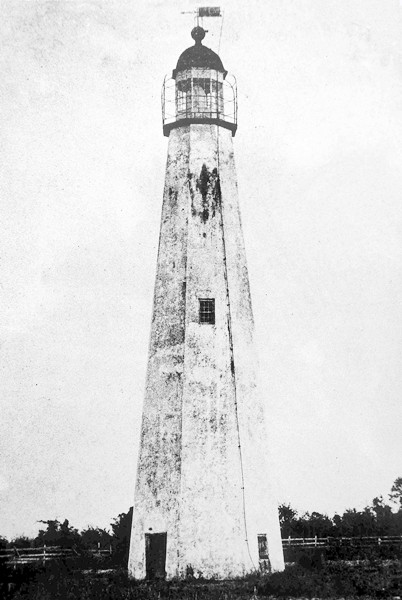
Gould used the ruins of Fort Frederica, which was built on the island in 1736, as a source for the tabby, and completed the seventy-five-foot tower in late 1810 at a cost of $13,775. Oil lamps suspended on chains served as the original light source.
With St. Simons Lighthouse finished, Gould was now out of work, but the following excerpt from a letter exchanged between two of his sisters reveals his time at the lighthouse was not yet done.
James has been officially appointed Keeper of the Light by President Madison, at a salary of $400 a year. The appointment came 4 May and he was, in spite of the small pay, plainly pleased to be trusted with the keeping of his beloved lighthouse. He appears also proud of the tower, so far, but what he insists is my discontent, I feel is somehow his own. I simply try to make him laugh and attempt to understand what it is he really wants to do with his life once the lighthouse is completed and he has been its keeper long enough to be satisfied that the lantern and all else is in order.
Apparently Gould was not too discontented with his life at the lighthouse as he served as keeper for twenty-seven years.
A residence was evidently not built with the lighthouse as James Gould was paid $1,700 in 1830 to build a keeper's dwelling. In 1838, it was noted that the tower's eight-inch reflectors were too small. This problem was corrected in 1847 when nine lamps with fourteen-inch reflectors were installed in the lantern room. In 1856, the lighthouse was outfitted with a third-order Fresnel lens.
When Confederate troops abandoned the island in 1862, they dynamited the tower and keeper's cottage, so they would not benefit Union forces.
Following the Civil War, noted Georgia architect Charles B. Cluskey drew up plans for a new lighthouse and dwelling on the island for which Congress had appropriated $45,000 on March 2, 1867. In the fall of 1869, a contract for the project was awarded to the lowest bidder with a completion date around the middle of the following year. Difficulties in procuring materials and landing them at the site resulted in the completion date being pushed back to November 1, 1870, but even this date would prove too ambitious. During the summer months, there was a great deal of sickness at the site, and the contractor fell ill and died. One of the contractor's bondsmen stepped in to complete the work, but he also passed away at the lighthouse.
The surviving bondsman stepped in in November 1871, when the lighthouse stood at fifty-one feet, and over the next several months managed to complete the impressive Victorian duplex and 104-foot tower. The light from a third-order, L. Sautter Fresnel lens was first shown on September 1, 1872. The lens is a fixed lens, meaning it does not contain any flash panels and thus produces a steady light, however, there are four flash panels that revolve around the outside of the lens producing a bright flash once per minute. Originally, the panels produced alternating red and white flashes, with intervals of one minute.
The keepers at the new lighthouse repeatedly complained about the unhealthy living conditions on the island. The Lighthouse Board finally took action in 1875 and drained the ponds near the lighthouse. Seeds of the Eucalyptus globulus tree were also planted at the station, as the trees were believed to neutralize the noxious gases that caused malaria. Only later was it learned that the trees helped prevent malaria by consuming large quantities of water, thus helping to drain the swampy areas where mosquitoes bred.
On a Sunday morning in March of 1880, Keeper Frederick Osborne and his assistant had an altercation on the lighthouse grounds, wherein the assistant shot Osborne dead. The assistant was later acquitted of murder charges, which may have prevented a peaceful rest for the departed Osborne, whose service was cut short. During Carl Svendsen's service as keeper, which lasted from 1907 to 1935, he and his wife repeatedly heard mysterious footfalls, which would send their dog Jink into a frenzy. To this day, people claim to hear inexplicable footsteps in the tower.
A speaking tube was installed in 1876 to connect the watchroom atop the tower with the dwelling so the relief keeper could be summoned. Keeper Isaac Peckham was lying down in the watchroom on the evening of August 31, 1886 when at 9:30 p.m. the Charleston earthquake shook the station. Keeper Peckhman reported that the accompanying noise "was like that made by a horse running over a hard road" and that one of the red flash panels broke. In May 1887, mother nature took another swipe at the station when lightning struck the dwelling. This prompted the addition of two new lightning conductors, with improved ground connections, to the dwelling.
The erection of a light to range with St. Simons Lighthouse and guide mariners safely into the harbor was proposed as early as 1837, but Congress didn't provide funds for it until 1893. The selected site for the beacon had to be obtained through condemnation proceedings, which delayed the establishment of the range light until May 1895. A triangular, skeletal tower, made of iron, was used to display a locomotive light at a focal plane of thirty-seven feet. This structure was destroyed by a hurricane on September 29, 1896 but was replaced the following month.
In 1890, a brick oil house was constructed on the lighthouse grounds to store the volatile kerosene, which replaced the increasingly expensive whale oil as the lamp fuel. The nine-by-eleven building could hold 450 five-gallon oil cans. Kerosene was in turn replaced by electricity in 1934, and the station was automated sixteen years later in 1950. Shortly after automation, the passageway connecting the tower to the dwelling was removed.
The keepers' dwelling was vacant for several years until it was leased to Glynn County in 1972 for use as a museum and visitors' center. After three years of restorative work overseen by the Coastal Georgia Historical Society, the museum opened to the public. The tower was opened in 1984 to climbers willing to brave the 129-step spiral staircase. Under the National Historic Lighthouse Preservation Act, ownership of St. Simons Lighthouse was officially transferred to the Coastal Georgia Historical Society on May 26, 2004.
Head Keepers: James Gould (1811 – 1837), Lachlan McIntosh (1837 – 1852), Alexander D. McIntosh (1852 – 1855), John F. Carmon (1855 – 1861), Bradford B. Brunt (1872 – 1874), Frederick Osborne (1874 – 1880), George W. Ashbell (1880 – 1883), Isaac L. Peckham (1883 – 1892), Joseph Champagne (1892 – 1907), Carl O. Svendsen (1907 – 1935), Arthur F. Hodge (1936 – 1945), David O’Hagan (1945 - 1953).
There were several historical markers around the lighthouse grounds which helped to tell the story of this beautiful structure:
There were several markers around the lighthouse grounds....All help tell the futher story of this beautiful light:


There were several markers around the lighthouse grounds....All help tell the futher story of this beautiful light:
In 1804, John Couper of
Cannon's Point Plantation sold 4
acres of land, known as Couper's
Point, to the U.S. Government
for the sum of $1.00. This is
the site where the first St.
Simons Lighthouse, built by
James Gould, was located.
The present lighthouse was commissioned by the U.S. Government in 1867 to be built adjacent to the site of the 1810 tower. The 104' tower and keeper's dwelling were designed by the noted architect Charles Clusky. Clusky and several of his crew members died of malaria during construction. The light and dwelling were completed in 1872.
The Lighthouse and Keeper's Dwelling Today
The lighthouse tower is of brick construction. Cylindrical in shape, it has a 129-step cast-iron spiral staircase. The foundation is 8' below ground, 30' in diameter, and 3' thick. In 1890, the fireproof oil house was constructed. The oil house was designed to hold 450 5-gallon containers of kerosene to light the lamp in the lantern room. Later, large oil drums were installed in the oil house to contain the fuel.
The Keepers Life
Several lighthouse keepers, such as C.O. Svendsen ( to your left), and their assistants did duty at this station. Often, the keeper's wife served as his assistant keeper. The lighthouse was completely automated in 1953. The early lives' of the keepers were lonely and monotonous. The Keeper's main task was to keep the light burning from sunset to sunrise. In addition, he was responsible for routine maintenance of the lens, buildings such as barns, boat houses, residence, and grounds.
The pay was $400 to $600 per year in the 19th Century. The highly prized position required the Keeper to be able to read and write, and sons often followed fathers and grandfathers footsteps into the United States Lighthouse Service
The Lighthouse and Keeper's Dwelling Today
The lighthouse tower is of brick construction. Cylindrical in shape, it has a 129-step cast-iron spiral staircase. The foundation is 8' below ground, 30' in diameter, and 3' thick. In 1890, the fireproof oil house was constructed. The oil house was designed to hold 450 5-gallon containers of kerosene to light the lamp in the lantern room. Later, large oil drums were installed in the oil house to contain the fuel.
The Keepers Life
Several lighthouse keepers, such as C.O. Svendsen ( to your left), and their assistants did duty at this station. Often, the keeper's wife served as his assistant keeper. The lighthouse was completely automated in 1953. The early lives' of the keepers were lonely and monotonous. The Keeper's main task was to keep the light burning from sunset to sunrise. In addition, he was responsible for routine maintenance of the lens, buildings such as barns, boat houses, residence, and grounds.
The pay was $400 to $600 per year in the 19th Century. The highly prized position required the Keeper to be able to read and write, and sons often followed fathers and grandfathers footsteps into the United States Lighthouse Service
Surely the most important aspect of the lighthouse to the mariner is the light that emanates from the tower. The tall, white beacon also serves as a day-mark. The light, a 1,000 watt electric bulb, is reflected by a fixed 3rd Order Fresnel Lens manufactured by L. Sautier of Paris. Four flash panels, mounted around a fixed lens, revolve around the bulb flashing one beam per minute. The beam projects out 23 miles, limited by the curvature of the earth.
Today, our lighthouse is under the jurisdiction and care of the United States Coast Guard, Aids to Navigation, Jacksonville Beach, Florida. The preservation of the historic structure on this site is the responsibility of the Coastal Georgia Historical Society.
Today, our lighthouse is under the jurisdiction and care of the United States Coast Guard, Aids to Navigation, Jacksonville Beach, Florida. The preservation of the historic structure on this site is the responsibility of the Coastal Georgia Historical Society.
In 1804, Scottish-born plantation owner John Couper sold four acres of land for $1 to the new United States government to build the first St. Simons Light Station.James Gould was hired to design and build the lighthouse and keeper's dwelling in 1807. It was constructed of tabby - a mixture of oyster shells, lime, sand, and water. It was first lit in 1811.
The first lighthouse was 75' tall, octagonal, 25' at the base and tapered to 10' at the top. The 10' iron lantern room had oil lamps suspended by chains as the illuminant. James Gould was also appointed head lighthouse keeper from 1811-1837.
In the summer of 1861, 1500 Confederate troops were stationed on this site at Fort Brown. In 1862, Confederate troops destroyed the first lighthouse before evacuating the island so that Federal Forces could not use it as a navigational aid. The occupying troops were the African American Union soldiers known as the 1st South Carolina Volunteers.
The Plantation Era
The Plantation Era began in the late 1700's and thrived on the growing of long staple cotton, known as "sea island cotton" and other crops such as indigo and rice. Cotton grew bigger and more plentifully here on the Georgia sea islands, and soon plantations were located from one
The first lighthouse was 75' tall, octagonal, 25' at the base and tapered to 10' at the top. The 10' iron lantern room had oil lamps suspended by chains as the illuminant. James Gould was also appointed head lighthouse keeper from 1811-1837.
In the summer of 1861, 1500 Confederate troops were stationed on this site at Fort Brown. In 1862, Confederate troops destroyed the first lighthouse before evacuating the island so that Federal Forces could not use it as a navigational aid. The occupying troops were the African American Union soldiers known as the 1st South Carolina Volunteers.
The Plantation Era
The Plantation Era began in the late 1700's and thrived on the growing of long staple cotton, known as "sea island cotton" and other crops such as indigo and rice. Cotton grew bigger and more plentifully here on the Georgia sea islands, and soon plantations were located from one
tip of St. Simons to the other. Although slavery was outlawed in early Colonial days, it became legal by 1757 in Georgia.
There is a strong connection between the Coastal sea islands and the Windward Coast of West Africa due to the slave trade that played such an important role in the success of area plantations. Slaves from West Africa were highly prized for their ability to cultivate rice, and then cotton. The War Between the States brought on the virtual demise of this era. The loss of slave labor made cotton growing and harvesting unproductive and not profitable. What remains is a cultural linkage between the "Gullah/Geechee" descendants of slaves of the sea islands and the countries of their ancestors.
A few tabby ruins remain of this era at Hampton Point, Cannon's Point and Retreat Plantation. Most of the old plantation lands have been covered by growth or converted to residential or commercial properties.
There is a strong connection between the Coastal sea islands and the Windward Coast of West Africa due to the slave trade that played such an important role in the success of area plantations. Slaves from West Africa were highly prized for their ability to cultivate rice, and then cotton. The War Between the States brought on the virtual demise of this era. The loss of slave labor made cotton growing and harvesting unproductive and not profitable. What remains is a cultural linkage between the "Gullah/Geechee" descendants of slaves of the sea islands and the countries of their ancestors.
A few tabby ruins remain of this era at Hampton Point, Cannon's Point and Retreat Plantation. Most of the old plantation lands have been covered by growth or converted to residential or commercial properties.